If you do outreach, you may be tired of the classics (slime, elephant toothpaste, flame test) and wonder how we can teach actual chemistry to young scientists in short 5-10 minute demonstrations.
While not necessarily mutually exclusive, having fun is not the same as being able to explain the chemistry.
More broadly, this idea has become a theme throughout our latest collaborations: translating cool visualizations into clear understanding for students, patients, and investors.
This week, we want to share evidence supporting how young scientists can build molecular literacy through computational chemistry when the visuals are designed to give them a question to explore, real stakes, and something to take home.
Before. Following the Slime Chemistry game's debut at ACS Spring 2026 in Atlanta, the feedback was clear: The connection between what kids did with their hands and what happened on the polymer chains was still fuzzy.
Side-by-side start screens of the Slime Chemistry game. Left, V1 Spring 2026. Right, V2 Fall 2026.
- The polymer strands did not behave enough like linked chains when hydrogen bonds formed.
- They needed an objective to aim for, not just a demo of the reaction to watch.
- We needed to communicate more clearly what the ingredients themselves mean to the solution being created and provide natural consequences for what happened when too much was added.
So, we rebuilt the game around the feedback and tested it on August 15 at Science Saturday with Dr. Celia Williams.
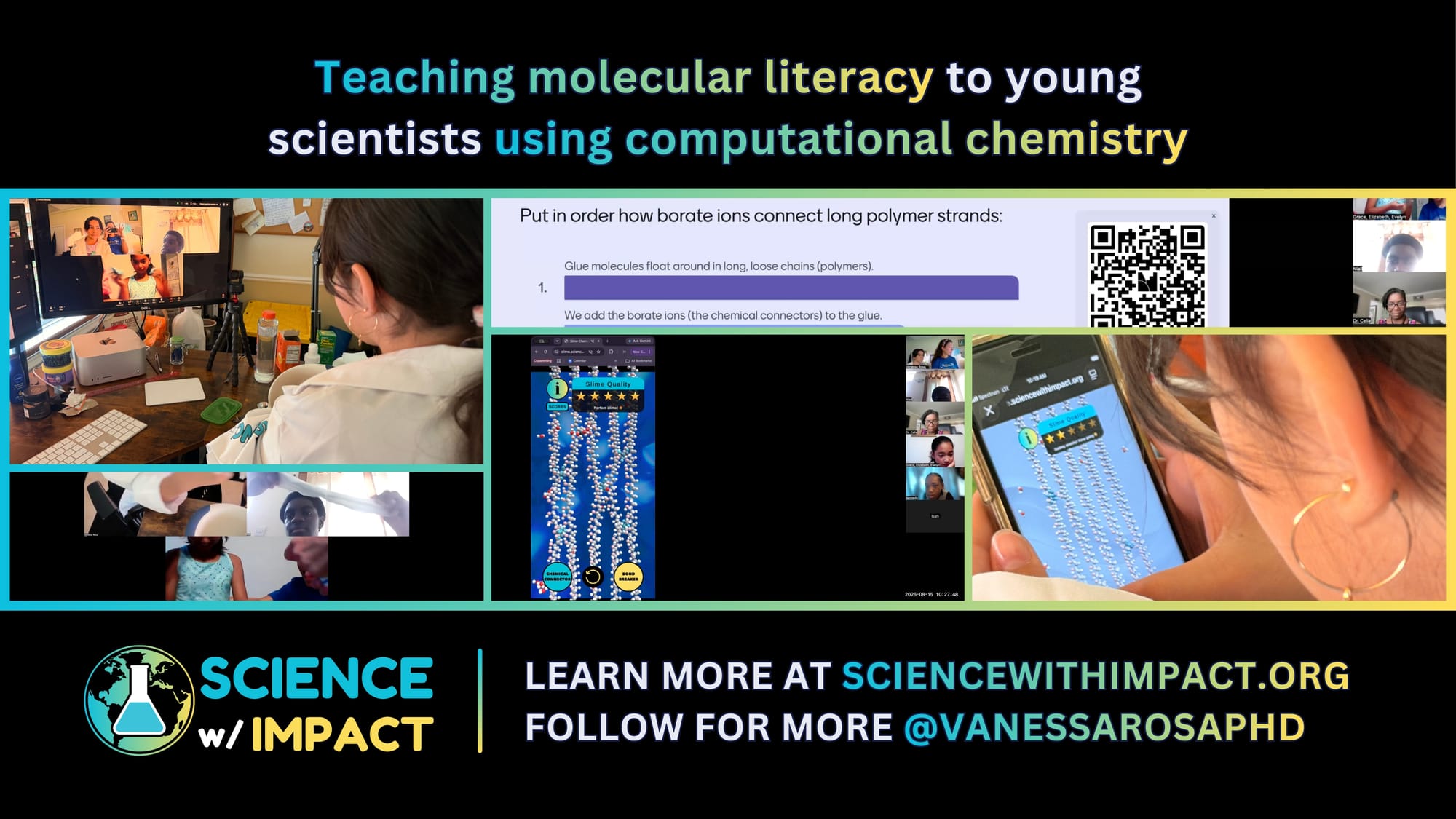
With a few edits, Version 2 was ready for ACS Kids Zone in Chicago on August 22 with the U.S. National Science Foundation's Center for Molecularly Optimized Networks (NSF MONET).
After. In Chicago we asked one question: what makes slime stretch?
Kids decided how much chemical connector (borate) and bond breaker (acetic acid / vinegar) to add on the phone, watched long polymer chains link or come apart, then made a real batch they got to keep.
They left with a sticker that said “Ask me why slime is stretchy!” so the explanation had somewhere to go after the table. ACS President Rigoberto Hernandez played a round and scored five stars.
In the thirty-day reporting window, the site recorded 114 unique visitors, 443 pageviews, and an average visit of 2 minutes 12 seconds, with 71 visitors on event day and 33 reaching the tracked achievement state.

That is engagement with understanding.
The lesson. Molecular literacy showed up when three design moves held at once:
- Keep it simple. One anchoring question. A few key players: long chains (polymers), chemical connector (borate), bond breaker (acetic acid). We could have drowned them in terminology and molecular dynamics. We did not.
- Real stakes. Let them make mistakes, not only follow a recipe. They chose how much connector and breaker to add, and the slime matched their experiment. When there was time, they tried again.
- Make-and-take. Send them home with something to explain. They kept the slime they made, for better or worse, and a sticker that invited the next conversation with a friend.
If you are a chemistry communicator designing an outreach station, a classroom activity, or a stakeholder demo, those three lessons are yours to take.
Try it out. Play the Chicago version yourself and tell us what you think:

If your lab or organization needs a custom interactive so stakeholders can follow your chemistry with the same clarity, start a request here:
 Vanessa Rosa, Ph.D.
It's a beautiful day to practice impactful science,
P.S. If you want to explore the simulator that made this outreach activity possible, feel free to explore Project Genesis:
 Vanessa Rosa, Ph.D.


Member discussion