How do you get a room full of people—many of whom have never attended a formal science lecture—to suddenly care about polymer chemistry?
You start with the Big Bang.
On June 6th, the David Ibbett composed the latest installment of the Art of Polymers series at the Harvard College Observatory, alongside animations, a simulation, and assessment by Vanessa Rosa, Ph.D..
Our theme was "Chemistry in the Universe."
The goal was simple but ambitious: address the challenge of "preaching to the choir" by using the awe-inspiring scale of astronomy as a gateway to introduce new audiences to network and polymer science.
Through a 90-minute immersive experience featuring a live talks from professors at Massachusetts Institute of Technology and The NSF-Funded Center for Chemical Innovation: Molecularly Optimized NETworks (MONET), a 50-minute Science with Impact animation, and avant-garde musical performances with the Multiverse Concert Series, we took the audience on a journey from the cosmos down to the molecular level.
But as science communicators, we know that hosting an event isn't the same as having an impact. We wanted to rigorously evaluate our societal footprint.
Here is what the data told us about the power of interdisciplinary science engagement:
📊 Reaching a Diverse Audience and Driving Conceptual Shifts
The “Chemistry in the Universe” concert successfully addressed NSF feedback by leveraging an astronomy-themed gateway to engage a diverse audience. Of 43 people completing both the pre- and post- live concert survey, 12 (28%) identified as artists, 13 (30%) as "not a scientist or artist," and 18 (42%) as scientists. This indicates successful engagement of a non-traditional STEM audience.
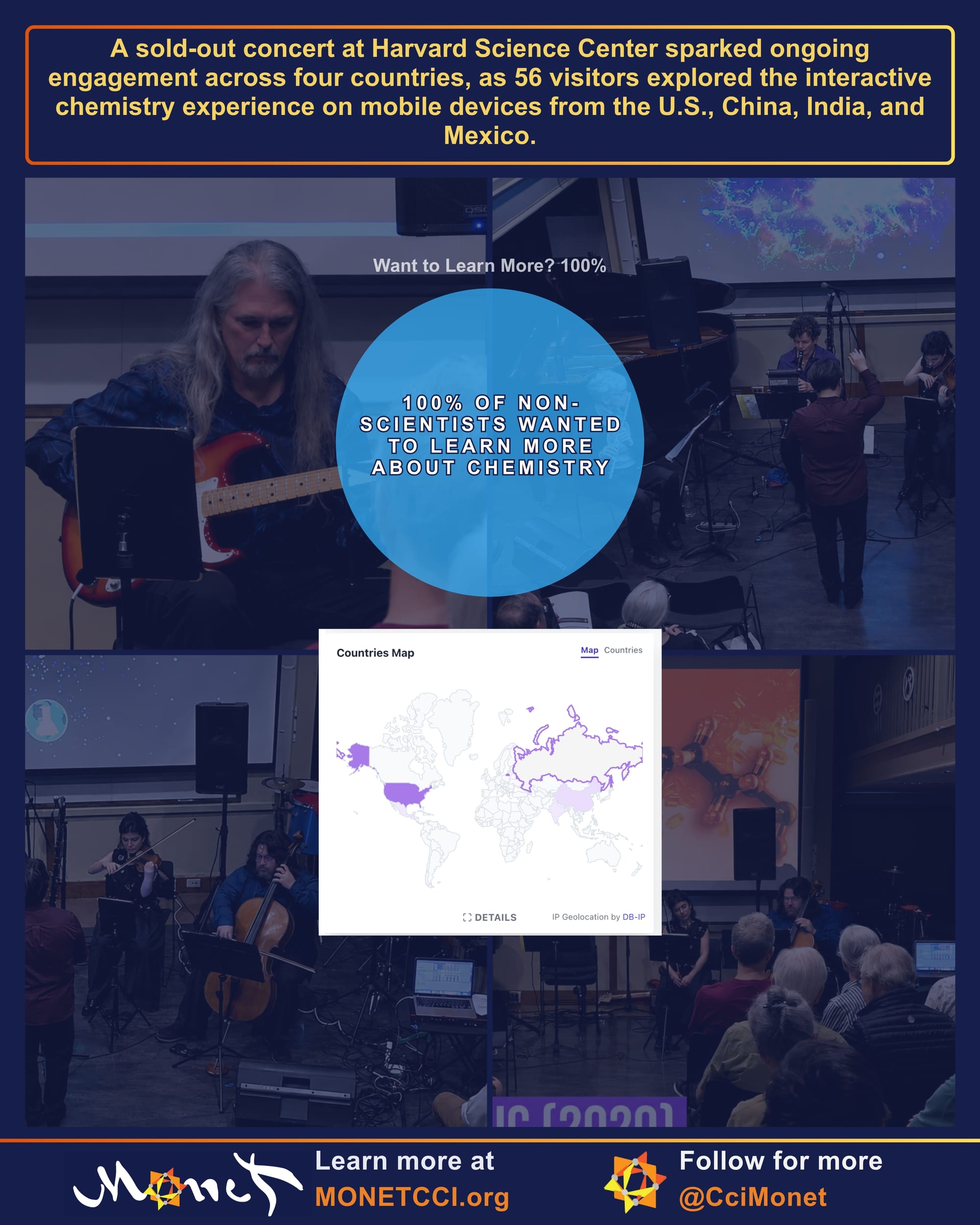
The audience skewed toward higher prior concert attendance (mean 77.4 on a 0-100 scale) but lower prior science lecture attendance (mean 50.5). This confirms the efficacy of the concert venue as a "gateway" to attract individuals who might not typically attend formal science lectures.
Over the course of the 90-minute event, the integration of collaborative animation, musical performance, and expert dialogue drove a substantial conceptual shift in attendees.
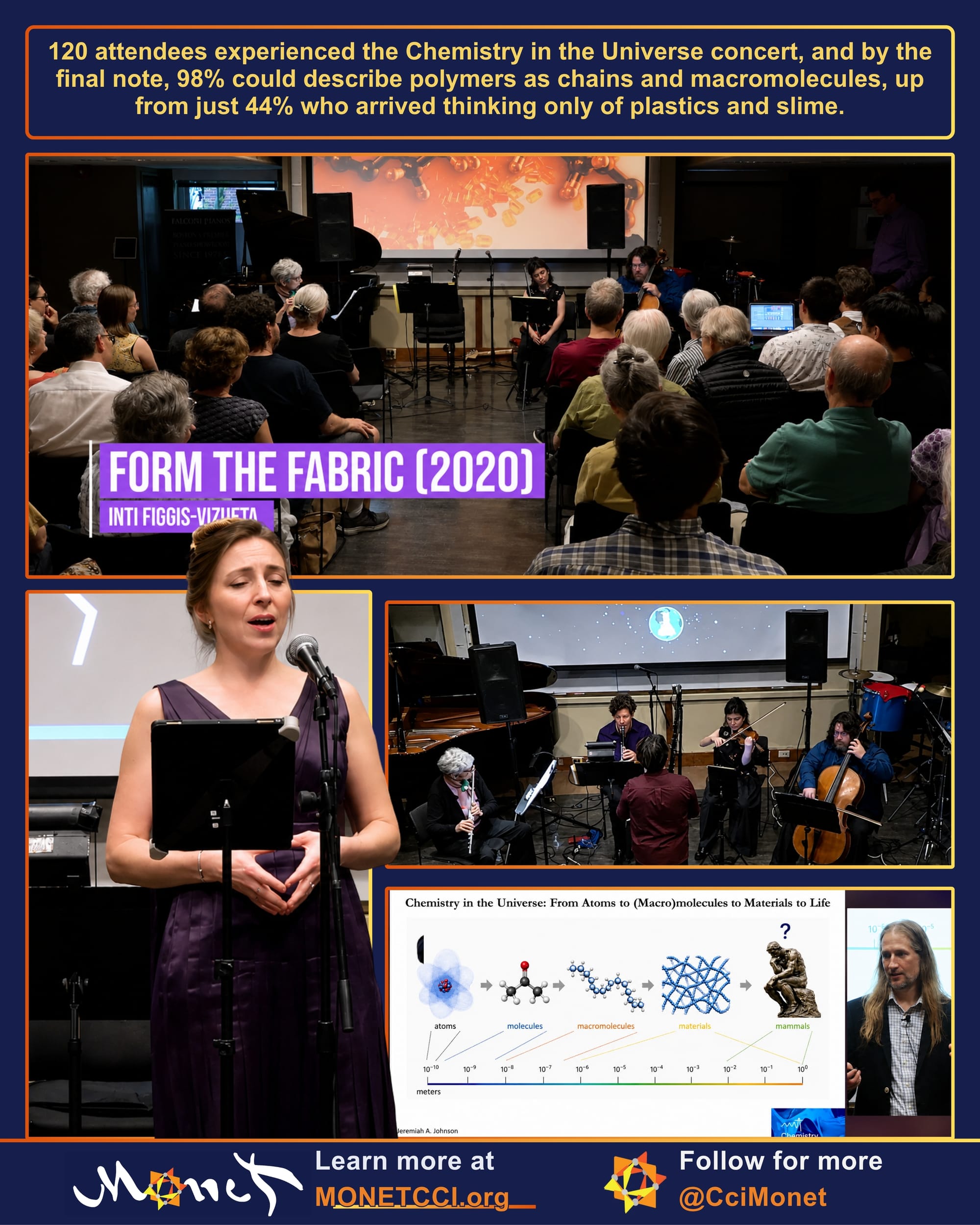
When asked to associate a word with "Polymer" before the concert, 44% of responses were everyday objects or surface-level associations. For example, some participants answered with "plastics," "rubber," "mermaid slime," or even "dad diapers" (a nod to the superabsorbent polymers, like sodium polyacrylate, used in adult incontinence products).
After the concert, 98% of responses utilized complex scientific terminology or structural descriptions. This 75% relative increase in scientific vocabulary demonstrates highly efficient knowledge transfer.
Visualizing the Conceptual Shift:
| Pre-Concert: Everyday Objects & Surface Associations | Post-Concert: Scientific Terminology & Structural Descriptions |
Plastics / Rubber | Chains / Macromolecules |
Dad diapers | Bonds |
Mermaid slime | Structure / Connectivity |
Nylon / Shellac | Carbon |
Sticky | Monomer |
A great name for a dog | Chain of molecules |
Orgo nightmares | Complex chemistry |
Audience feedback strongly affirmed the approach, with 96% expressing a desire to learn more about chemistry and describing the experience as a "fascinating" and "brilliant amalgamation of music and science.”
🎮 The "Multiverse" Simulation: Gamifying the Cosmos
A core component of our strategy was extending the engagement beyond passive listening. We developed a collaborative, interactive 3D simulation (universe.sciencewithimpact.org) designed to run before, during, and after the performance. The app allowed users to actively explore the universe's progression from energy to atoms to molecules.

Click to play!
The reception to this visual and interactive element was incredible. In the open-ended feedback, attendees described the concert using words directly inspired by the simulation, such as "Cosmic," "Stelar," and "Big bang."
One participant explicitly noted:
"Awesome, loved the game and the speakers and the music."
Another highlighted the integration, calling it a "Spacey quirky fun educational" experience.
Overall, audience feedback gave the simulation a stellar 4.2 out of 5.0 rating for helping to connect chemistry with the universe.
We also looked under the hood at the live app analytics during the event, and the engagement was fantastic:
- 19 unique visitors actively played the simulation during the concert.
- The average visit duration was a highly engaged 4 minutes and 55 seconds.
- We tracked players' progress through the chemical evolution stages: 10 users successfully spawned the very first Up/Down Quarks (Stage 1), several successfully fused Helium in the core of early stars (Stage 4), and one intrepid explorer even made it all the way to building Water and Methane (Stage 8) right from their seat!
This active participation reinforced the "macro + micro clarity" we were aiming for—showing the big-picture progression of the universe while highlighting the smaller, localized scientific stories of molecular bonds.
🚀 The Momentum of Curiosity
The true measure of a broader impacts initiative is what happens after the audience leaves the venue. But, of course, measuring that is the hard part.
By meeting people where they are—at the intersection of art, music, and the cosmos—we can efficiently and profoundly shift how they understand the molecular building blocks of our world.
As one participant beautifully summarized the night's impact:
Reignited my interest in chemistry and astrophysics. ... I realized so much interesting stuff about myself and the world.
Want to learn more about how we evaluate our broader impacts? Check out our recent case studies and stay tuned for the next installment of the Art of Polymers series!


Member discussion