
What happens when you treat chemistry communication like a systems problem instead of a static media project?
On June 6, 2026, something unusual will happen at Harvard’s Center for Astrophysics: an audience will gather for music—and also for chemistry on a cosmic scale. The score is not an afterthought to the science, and the science is not wallpaper for the score. They are being composed together.
So how do you rehearse a universe?
From the concert hall to “play the Big Bang.”
Most planetarium shows ask you to watch. This collaboration asks something sharper:
What if you could both watch the story of matter and play it afterward?
That is the bet behind Science with Impact's work for the Multiverse Concert Series, with music composed by Prof. David Ibbett (Multiverse) and presented by Prof. Jeremiah Johnson of MIT Department of Chemistry—also a Senior Investigator at the The NSF-Funded Center for Chemical Innovation: Molecularly Optimized NETworks (MONET). With MONET support, the project is delivering two outputs that are intentionally tight siblings rather than two unrelated demos:
The engine underneath is Genesis— Vanessa Rosa, Ph.D.’s Unity-based simulation framework that treats particles, nuclei, valence, and molecules as things you can stage, steer, and stress-test like a physical model—except this one can fill a screen, a theater, and a curious stranger’s evening:

What “success” means when the concert is full
- For the concert: a film that plays smoothly, lands the intended beats (Big Bang → particles → atoms → molecules → polymers), and can sit in a live program without technical surprises—because surprises on June 6 would not be charming.
- For Genesis: a more capable baseline—especially around molecular interactions and polymerization—that makes the film possible now, strengthens the engine for future polymer-chemistry work, and remains playable and entertaining for the public: the kind of experience that makes someone lean in and think, “Wait—that emerged because I turned the dial?”
- For the audience: Connecting chemistry to space exploration, bringing in an audience who may not have considered the connections between the physics of galaxies and those at the submicroscopic level.
If the audience leaves with both a feeling and a question, we succeeded!
So, we implemented a live and post-viewing assessment strategy using Mentimeter and structured response prompts to evaluate:
- what viewers understood about reaction progression
- which visuals improved chemistry intuition
- where additional teaching support is still needed
We will publish a summary of what the assessment data shows after enough responses are collected.
How Genesis turns astrophysics into something you can run
The approach is “show the ladder” without pretending the universe is a PowerPoint.
1. A deterministic “film take” inside the same engine as the game
Genesis includes a film director for a dedicated Director scene: fixed seeds, controlled capture cadence, camera choreography, and a scripted arc that can walk from energy and motes toward macro chemistry—without pretending every frame of a concert film should be left to pure chance.
The intent is captured plainly in the code’s own description of FilmQuantumDirector:
/// <summary>
/// Quantum film take for <c>Director.unity</c>: fixed RNG, optional fixed capture frame rate, particle seeds,
/// <see cref="CameraOrbit"/> bypass, slow orbit, Big Bang, slow mote differentiation, then a guided tour
/// (elements → molecules toward poly(ethyl acrylate) precursors, or full table if PEA path is off → Brønsted pair).
/// </summary>
Translation for a non-programmer reader: the concert film is not a separate movie universe—it is a disciplined performance mode of the same universe the public can later play with.
2. Nucleons don’t “become atoms” by magic—they are assembled
When clusters of nuclear matter meet the right conditions, Genesis instantiates an atom and assigns it a real proton/neutron count—then clears the ingredients so the simulation stays physically readable instead of visually cluttered.
        if (atomPrefab != null)
        {
            GameObject atomObj = Instantiate(atomPrefab, centerPos, Quaternion.identity);

            AtomContainer container = atomObj.GetComponent<AtomContainer>();
            if (container != null)
            {
                container.AddNucleon(p, n);
            }
            Debug.Log($"Nucleon Synthesis: Created {container.isotopeName}");
            FreeLeptonCosmicCull.SubtlyDestroyRandomFreeLeptons(3);
        }
That last line is a good example of the project’s tone: rigor where it teaches, storytelling where the public eye lives—a gentle cinematic beat around free leptons so the stage doesn’t turn into particle confetti.
3. Fusion is a place, not just an effect
Genesis models a stellar core region where certain collisions can do what cores do: build heavier nuclei without requiring Hollywood collision speeds everywhere. Tunables like core radius and contact fusion make the ladder from light nuclei to richer chemistry stageable rather than accidental.
    [Header("Stellar core")]
    [Tooltip("When both atoms lie inside this radius of the origin, qualified pairs fuse on contact (no high-speed hit needed).")]
    public bool allowStellarCoreContactFusion = true;
    [Tooltip("Distance from world origin treated as the stellar core (world units).")]
    public float stellarCoreRadius = 45f;
    [Tooltip("Legacy: outside contact-core mode, low-speed threshold inside core (unused when contact fusion is on).")]
    public float coreFusionVelocityThreshold = 14f;
If that reads like a flight simulator’s autopilot settings, good: the goal is controllable awe.
4. Chemistry is an interaction law, not decoration
Under the hood, bonding and reactivity tie into systems like valence shells, bond formation, and molecular structures loaded from authored assets—so “water” is not a texture; it is a structure that has to coexist with forces, motion, and player curiosity.
That is the long arc the concert wants to feel: rules accumulate into richness.
Why this approach is innovative (and where to see the dashboard)
Most chemistry visuals are polished, but rigid. If the science changes, the media pipeline often has to be rebuilt by hand.
Our approach is different:
- 57,378 lines of C# code for simulation-driven structure and reaction logic
- 115 reusable assets & scene-direction tooling in Unity (Director workflow)
- data-backed iteration rather than one-off rendering
This lets us tune reaction behavior, discovery moments, pacing, and educational flow without re-keyframing every revision.
Estimated effort comparison
For a 50-minute chemistry visual with this depth of molecular progression:
- Traditional keyframe-only workflow (estimated): ~1,500-2,500 hours (often 9-15+ months, depending on team size and revision cycles)
- Simulation-first workflow (our pipeline): higher up-front systems engineering, then rapid reuse and revision across scenes, beats, and science updates
In short: we invest in engines and logic once, then scale creative output faster and with higher scientific consistency.
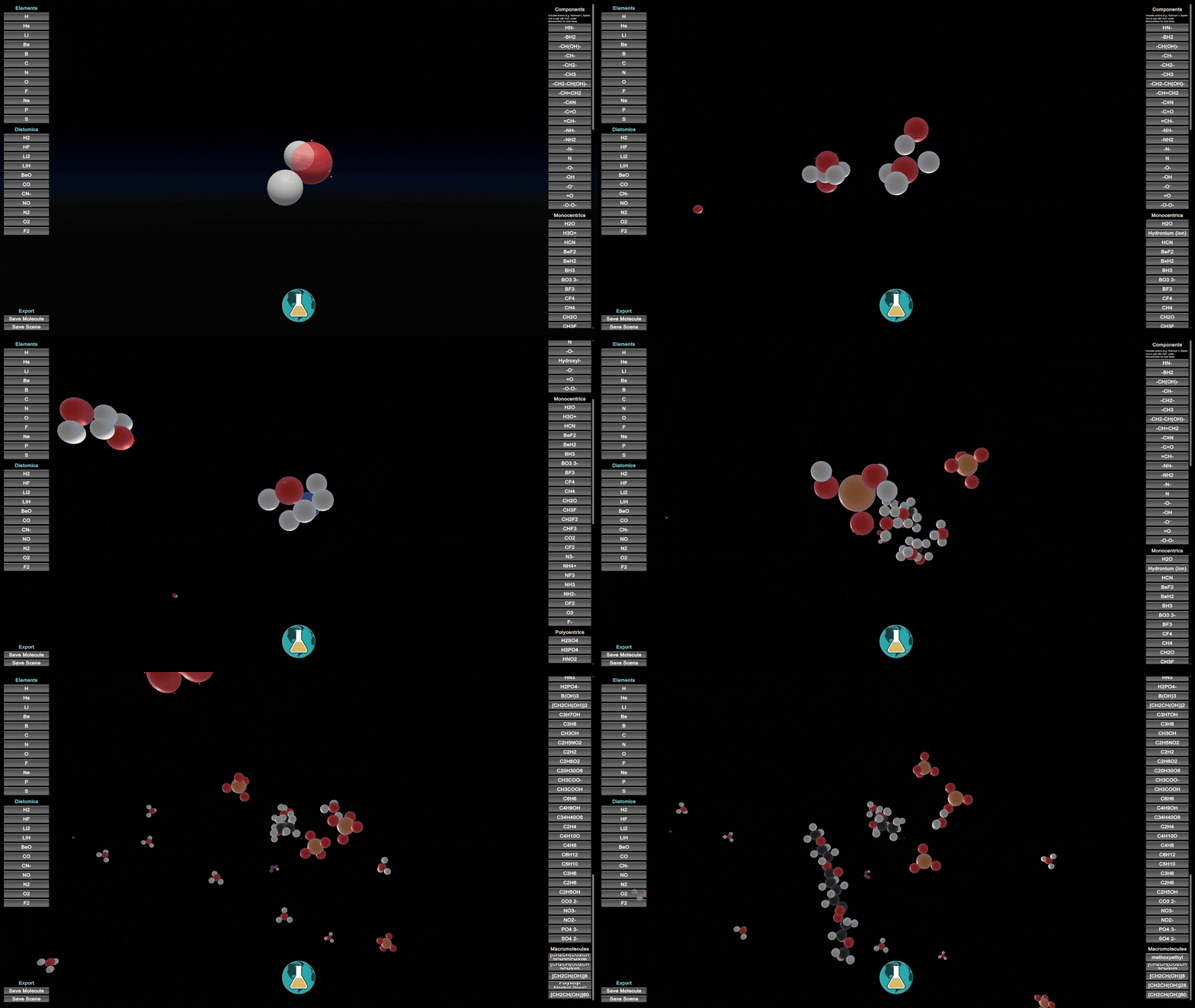
Do you want to make your mechanism interactive?
Interactive 3D Chemistry + Reportable Impact Metrics
Request a VisualSave the date—and the question
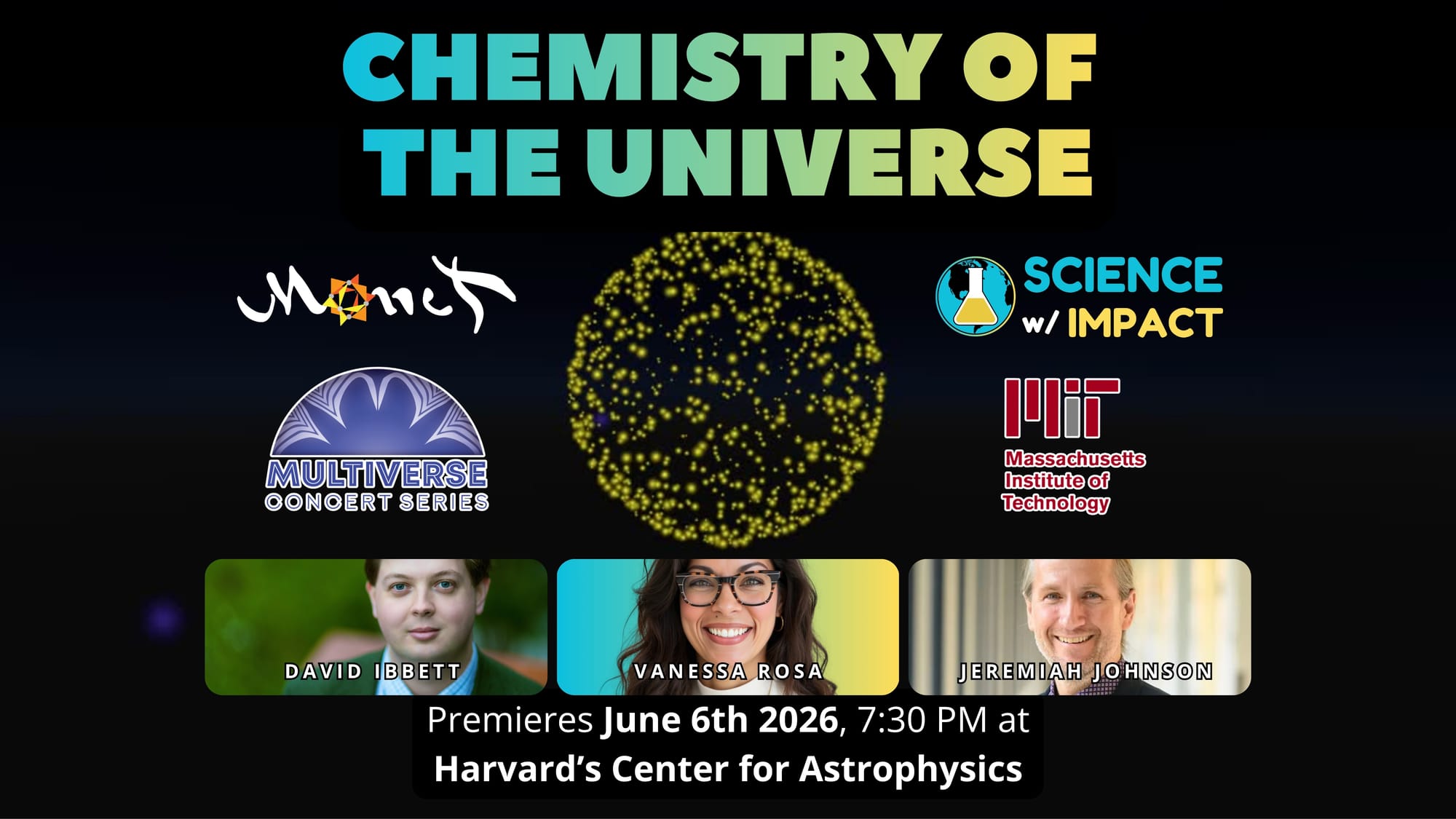
Debut: June 6, 2026, 7:30 PM ET, Harvard Center for Astrophysics—music, visuals, and a playable universe built from the same scientific imagination.
If you are the kind of reader who likes a single sentence to walk away with, make it this one:
We are not illustrating chemistry for a concert—we are building a universe that can be both performed and played, then inviting the public to ask what else it can become.

We believe that scientific progress should inspire the public, and vice versa. Our mission is to support our colleagues in achieving, measuring, and defending their broader impacts.


Member discussion