
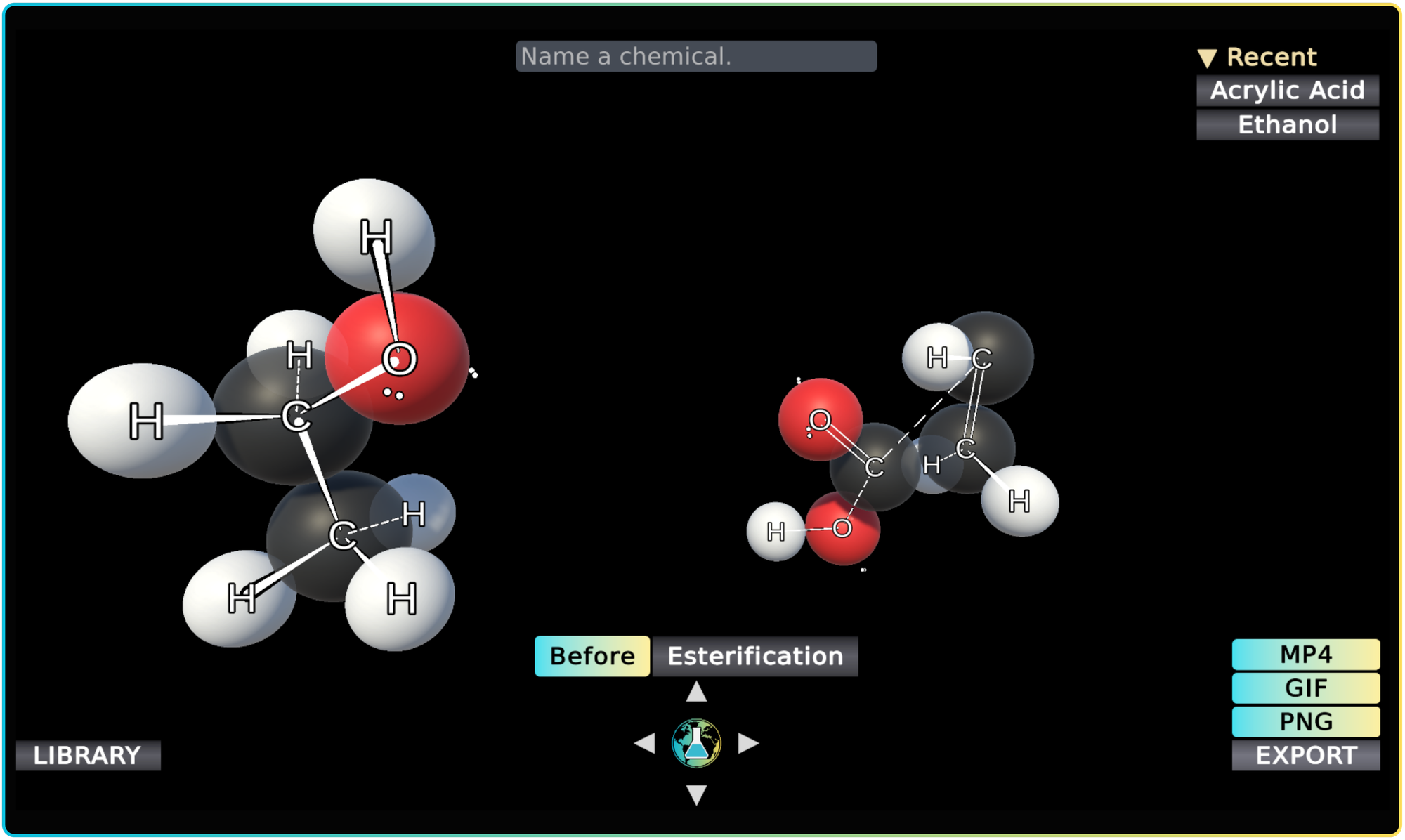
Make chemistry mechanisms interactive
Try the Genesis AppWhy interactive?
Move from passive visuals to chemistry your audience can interact with and explore in the browser.
Surface molecular dynamics, step by step
Surface molecular dynamics, step by step
Standard animation software creates inert 3D models. We build interactive simulations using computational chemistry, so your audience can clearly see the dynamic, step-by-step process of your specific molecular mechanism.
Investigate cause-and-effect relationships
Investigate cause-and-effect relationships
Move beyond static diagrams and dead 3D viewers. Reviewers, students, and peers can manipulate conditions and observe exactly how your specific chemical systems respond in real time.
Evidence-ready impact metrics
Evidence-ready impact metrics
Strengthen your next proposal or paper and save writing time with a bespoke interactive web model: tracked viewer engagement, user feedback, and an impact slide ready to report.
Frictionless, web-based access
Frictionless, web-based access
Unlike heavy molecular modeling software, your audience needs no training, coding, or downloads. You share a single, secure web link so funders or the public can open your interactive mechanism instantly.
Delivered on your timeline
Delivered on your timeline
Built by scientists with deep science communication experience, our vendor-approved service translates your research into interactive models in a transparent 21-day sprint, scoped to your available grant allocation.
Powered by the Genesis App
Dr. Rosa developed Genesis to help other chemistry communicators "surface the mechanism" behind observable phenomena important to their causes.
Rather than passively viewing an animation, learners and collaborators can select conditions, test predictions, and investigate the cause-and-effect relationships of a mechanism in real time:
- Test Genesis: Jump into a live, interactive simulation to manipulate conditions and explore our 3D mechanics firsthand.
- Open Chemistry Library: Access our public repository of baseline, non-proprietary WebGL models for testing and exploring.
- Monthly Additions: New structures, reactions, and mechanisms added each month by request from our Pro subscribers and clients!

Custom, interactive chemistry apps have been made for:





Past Clients and Collaborators
FAQs
Custom projects: billed at $185/hr under a not-to-exceed cap you set — a typical interactive mechanism is about 40 hours.
How is this different from standard molecular modeling software (like PyMOL)?
Standard modeling software is incredibly powerful for rendering static structures or pre-calculated trajectories. However, it isn't built for interactive public sharing. Genesis is a live, game-engine environment.
By programming the chemical logic (e.g., electrostatics, valence) directly into the system, we allow your audience to manipulate variables and investigate cause-and-effect in real time, directly in their web browser without downloading any heavy software.
What does the Science with Impact team deliver?
We are a university-approved research support vendor that translates your computational chemistry into interactive 3D simulations. Rather than delivering a passive video, we provide:
- A Custom Interactive Simulation: A web-based model of your specific mechanism where users can manipulate conditions and investigate cause-and-effect.
- Zero-Friction Hosting: Permanent hosting of your interactive simulation on a dedicated, secure webpage.
- Evidence-Ready Metrics: Impact analytics and tracked engagement data that you can drop directly into your grant reports.
- Broad Outreach: A media spotlight feature on the Science with Impact Podcast.
Our ultimate goal is to give you mechanistic clarity—helping you secure funding and enhance presentations by allowing reviewers and students to explore your chemistry in real time.
How does pricing and procurement work for academic grants?
We strive to be 100% procurement-friendly and flexible for university grant structures.
- Scope-Based Budgeting: We bill an hourly rate ($180/hr) under a Not-to-Exceed (NTE) cap that you set. A typical interactive mechanism requires ~40 hours, but you only pay for the exact time used.
- Procurement-Friendly: We operate on auditable Net-30 invoices, billed every 6 weeks, and handle the vendor approval process for your department.
- Limited Capacity: To ensure quality, we take on 1 project per month and are typically booked 2–6 months in advance (rush options available).
- The Accuracy Guarantee: If the delivered interactive simulation does not meet our agreed-upon scientific accuracy and performance targets, we will refine it at no additional labor cost until it does.
How do we get started?
We keep the PI lift minimal. To request a custom quote, just send us these three project details via our request form:
- The Mechanism: What specific chemical process or key point do you need the viewer to understand?
- The Audience: Who will be interacting with this? (e.g., NSF grant reviewers, students, a conference audience, the public).
- The Outcome: What decision does this support? (e.g., proposal clarity, teaching module, broader impacts outreach).
Once submitted, we will reply with a recommended scope, an estimated hour range, and a timeline for your grant budget.
Scientific progress to inspire the public, and vice versa.