In a world saturated with information, how do you ensure your scientific voice is heard? The answer is not about shouting louder, but about cultivating authenticity and clarity in your communication.
Dr. Vernetta Mosley, founder of Cultivate the Writer and expert in academic communication, joins us to explore how scientists can develop their unique voice in writing and speaking. With a PhD in English and over a decade of experience helping researchers communicate more effectively, Vernetta brings a refreshing perspective on the intersection of technical expertise and human connection.
This episode of Science With Impact explores the often-misunderstood concept of "soft skills" and reveals why these human capabilities are essential for scientific impact.
Whether you're writing grant proposals, presenting at conferences, or communicating your research beyond your immediate field, this episode offers practical wisdom for finding and strengthening your authentic voice.
Meet Dr. Vernetta Mosley
Dr. Vernetta Mosley is the founder of Cultivate the Writer, a company dedicated to helping academics connect with their authentic voice in writing and communication. With a PhD in English and over a decade of experience supporting researchers across disciplines, Vernetta brings a unique perspective on academic communication that bridges technical expertise with human connection.
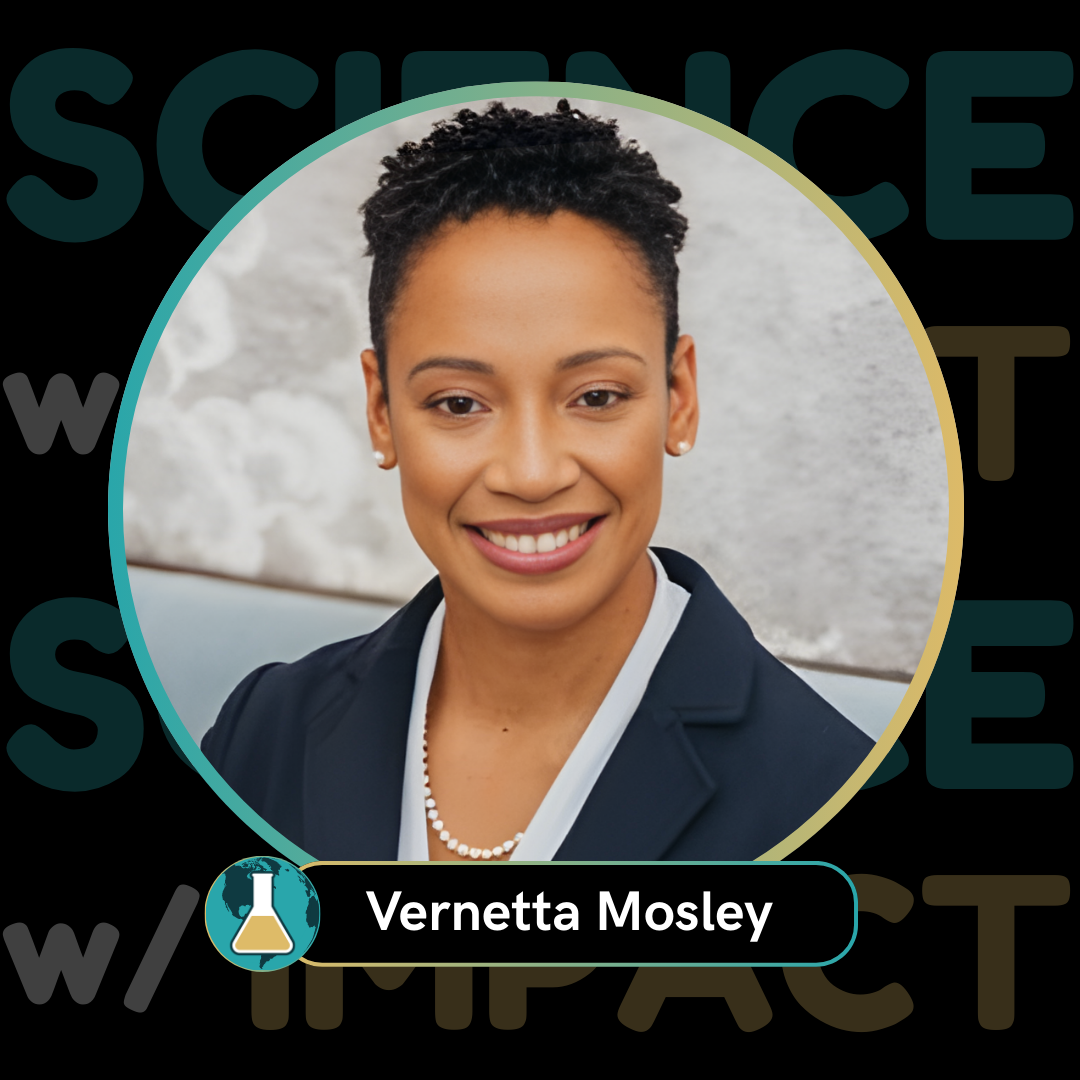
Her journey through academia as a Black woman beginning in 1999 shaped her understanding of the challenges researchers face in developing their voice within traditional academic spaces. Despite being groomed for a tenure-track faculty position, Vernetta made a bold choice in 2008: she stopped asking for permission and pursued an entrepreneurial path aligned with her values.
"I can always go back into higher education and teach if this doesn't pan out," she told herself in 2011 when starting her company, "but I have to pursue what's in my heart." Years later, that leap of faith has blossomed into a thriving business helping others who lack formal writing training but desperately need these skills to succeed.
Through Cultivate the Writer (officially Chrysalis Consulting), Vernetta provides writing support and dissertation coaching to graduate students and faculty. The name reveals her philosophy: like a chrysalis protects a caterpillar transforming into a butterfly, she creates a safe space where researchers can develop their skills before releasing their work to the world. She has established strong partnerships with doctoral programs, including a DBA program at the University of South Florida, where she helps students navigate what she calls "the often traumatizing process of academic critique" while maintaining confidence in their unique contributions.
Vernetta's approach centers on a fundamental principle that transforms how researchers think about writing: "Writing is just a picture of your thoughts."When writing feels confused or unclear, she helps researchers step back to clarify their thinking first—identifying their specific audience, purpose, and unique perspective before putting words on the page.
What makes her work especially powerful? She goes by "Dr. V"—a strategic choice.
"I wanted to be recognized for my expertise,but I also wanted to be accessible. I'm here with you. I have the credentials, but I'm here for you to be vulnerable, for you to ask the questions that you don't ask."
Every presentation she gives starts with her own story and struggles, because as she puts it:
"I haven't arrived. I'm still learning. I'm still growing. I'm still a human being."
The Power of Human Skills in Science
We often hear about "hard skills" versus "soft skills" in academic and professional settings. But Vernetta challenges this framing entirely. What we call soft skills are actually fundamental human capabilities that determine whether our technical expertise ever reaches its intended audience.
Vernetta shares a powerful story from early in her career when she stepped into a leadership role and encountered a room full of complaints with no solutions. Her ability to remain solution focused, to build relationships, and to facilitate productive conversations became the differentiator. These are not innate gifts but developed capacities that require intentional cultivation.
Finding Your Voice When Academic Culture Has Silenced It
One of the most profound challenges scientists face is rediscovering their authentic voice after years of academic conditioning. The peer review process, while essential for scientific rigor, can be deeply traumatizing to a writer's confidence. Critique after critique can leave researchers writing in a defensive, timid voice that hides rather than highlights their unique contributions.
Vernetta introduces a fundamental principle: writing is simply a picture of your thoughts. When writing feels confused or unclear, it often means the thinking has not yet crystallized. Many scientists start writing too soon, before they have fully processed what they want to say about their data and findings.
The solution is not to write more, but to think more intentionally. Consider these questions before drafting:
- Who is my specific audience for this piece of writing?
- What is my purpose in communicating with them?
- What unique perspective or insight do I bring that no one else can offer?
- Am I writing for discovery or for dissemination?
That last distinction is critical. Writing for discovery is the messy, exploratory process where you figure out what you think. Writing for dissemination is the polished, audience focused communication of those insights. Conflating the two creates unnecessary frustration.
Using AI Ethically in Scientific Writing
With AI writing tools proliferating rapidly, scientists face new questions about how to use these technologies without compromising intellectual property or authentic voice development.
Vernetta offers clear guidance grounded in both ethical and legal considerations. For scientists working with intellectual property, extreme caution is warranted. When you input your unique ideas, data, or findings into AI tools, you are feeding databases that may be used in ways beyond your control or intention.
Several court cases are now addressing whether AI companies violated copyright by training models on protected work without permission. The legal landscape is evolving, but current law states that only human generated content can be copyrighted. This has significant implications for scientists whose careers depend on protecting and being credited for their intellectual contributions.
Where AI can be useful:
- Brainstorming initial ideas and frameworks
- Organizing thoughts into preliminary outlines
- Clarifying thinking through conversational iteration
- Drafting routine communications that do not contain proprietary information
Where AI should be avoided:
- Writing that reflects your unique thinking and intellectual contributions
- Any content involving proprietary research data or findings
- Communications that represent your authentic voice and perspective
Most importantly, always follow your institution's guidelines on AI use, and when you do use AI tools, document and acknowledge how they were employed in your work.
Your Roadmap to Cultivating Your Scientific Voice
Developing your scientific voice isn't just about better writing—it's about amplifying your research impact. This roadmap translates Dr. Vernetta Mosley's insights into ten practical steps that help you move from formulaic academic writing to authentic, compelling communication.
Whether you're struggling with peer review feedback that's eroded your confidence, trying to clarify muddled thinking before drafting, or navigating career paths beyond traditional academia, this guide offers concrete actions you can take immediately. Each step includes specific exercises designed to cultivate—not create—the unique voice that already exists within you.
Your technical expertise is valuable, but your voice is irreplaceable. Use this roadmap to develop the communication skills that transform your discoveries into societal impact.
Step 1: Recognize That Your Voice Is Your Only Unique Contribution
In a world saturated with research, your voice is the only element no one can replicate. Your methods can be learned, your techniques adopted, but your perspective—shaped by your unique combination of experiences, training failures, and unexpected insights—belongs only to you.
Action: Complete this exercise: Write down three research experiences that shaped how you think about your work—including at least one failure or pivot. What connections do you see now that you didn't recognize when others were looking at the same data? This is your unique perspective.
Step 2: Understand That Writing Reflects Your Thinking
When your writing feels confused, you haven't started writing too soon—you've started before clarifying your thinking. As Vernetta emphasizes: "Writing is just a picture of your thoughts."The solution isn't better writing technique; it's clearer thinking.
Action: Before drafting your next paper section, spend 15 minutes answering these questions on paper:
- Who exactly needs this information? (Be specific—not "other researchers" but "materials scientists working on polymer degradation")
- What decision or understanding will this enable for them?
- What insight am I offering that they can't get elsewhere?
- Am I writing to figure out what I think (discovery) or to communicate what I've concluded (dissemination)?
Step 3: Separate Writing for Discovery from Writing for Dissemination
Writing for discovery is messy, exploratory work where you think through problems. Writing for dissemination is polished communication of conclusions. Treating them as the same process creates paralysis.
Action: Block 20 minutes this week for discovery writing. Set a timer and explore: What surprises me most about my current results? Why does this work matter beyond my field? What am I still uncertain about? Write continuously without editing. This isn't your draft—it's your thinking becoming visible.
Step 4: Reframe "Soft Skills" as Essential Capabilities for Scientific Impact
Communication, collaboration, and critical thinking aren't secondary to technical expertise—they're the mechanisms through which your scientific knowledge creates change. A discovery that cannot be communicated creates no societal benefit.
Action: Identify one communication skill you'll develop this quarter. Practice it systematically: If it's visual communication, create one figure per week and get feedback. If it's oral presentation, record yourself explaining one concept monthly. Track how this skill amplifies your technical work's reach.
Step 5: Build Resilience Against Academic Critique
The peer review process strengthens scientific rigor but can erode your confidence as a writer. Repeated critique can leave you writing defensively, hiding your contributions rather than highlighting them.
Action: After receiving critique, take 24 hours before responding. Then identify one piece of feedback that strengthens your argument and one that reflects reviewer assumptions rather than flaws in your work. This distinction helps you internalize useful critique without absorbing unwarranted criticism.
Step 6: Use AI Cautiously and Strategically
AI tools can accelerate brainstorming and organization but should never replace the thinking that makes your work uniquely valuable. Content generated by AI cannot be copyrighted—a critical consideration for protecting your intellectual contributions.
Action: Create a decision tree: Use AI for routine communications that don't contain proprietary information. Never use AI for writing that reflects your unique analysis, interpretation, or intellectual property. Check your institution's AI policy and document every instance of AI use in your workflow.
Step 7: Follow Your Energy as Data
Your physical and emotional responses to your work provide clear signals about alignment. When Vernetta describes feeling energized even when exhausted while teaching, that's her body confirming purpose alignment.This data is as meaningful as any experimental result.
Action: For one week, note your energy level after each major work activity (0-10 scale). Which tasks energize you even when you're tired? Which drain you despite being "successful"? Patterns in this data reveal where your skills and purpose intersect—and where they diverge.
Step 8: Cultivate Rather Than Create Your Voice
Your voice already exists within you. The work isn't manufacturing something new but nurturing what's already there through protected space for growth—like a chrysalis protecting a developing butterfly.
Action: Find or create one low-stakes environment where you can practice developing your voice: a writing group with trusted colleagues, a mentorship relationship focused on communication, or a professional development program. Commit to sharing work-in-progress in this space monthly.
Step 9: Know Your Audience and Speak Their Language
Being a scholar means translating complexity for specific audiences. The vocabulary that works for peer reviewers fails when communicating with practitioners, policymakers, or public audiences.
Action: Take your most recent paper abstract. Rewrite it three times: once for a scientist in a different field, once for a policymaker who controls funding decisions, and once for an intelligent non-scientist. Notice what changes. These translations aren't "dumbing down"—they're strategic communication.
Step 10: Commit to Continuous Growth
Every writer improves with practice and feedback, regardless of credentials. Vernetta holds a PhD in English and still edits every piece she writes. Viewing growth as perpetual rather than destination-oriented sustains long-term development.
Action: Identify one person whose feedback you trust and ask them to review one piece of your writing monthly. Specify what kind of feedback you need: clarity, structure, voice, or audience appropriateness. View revision as the natural process of refinement, not evidence of failure.
Key Takeaways For Authentic Scientific Communication
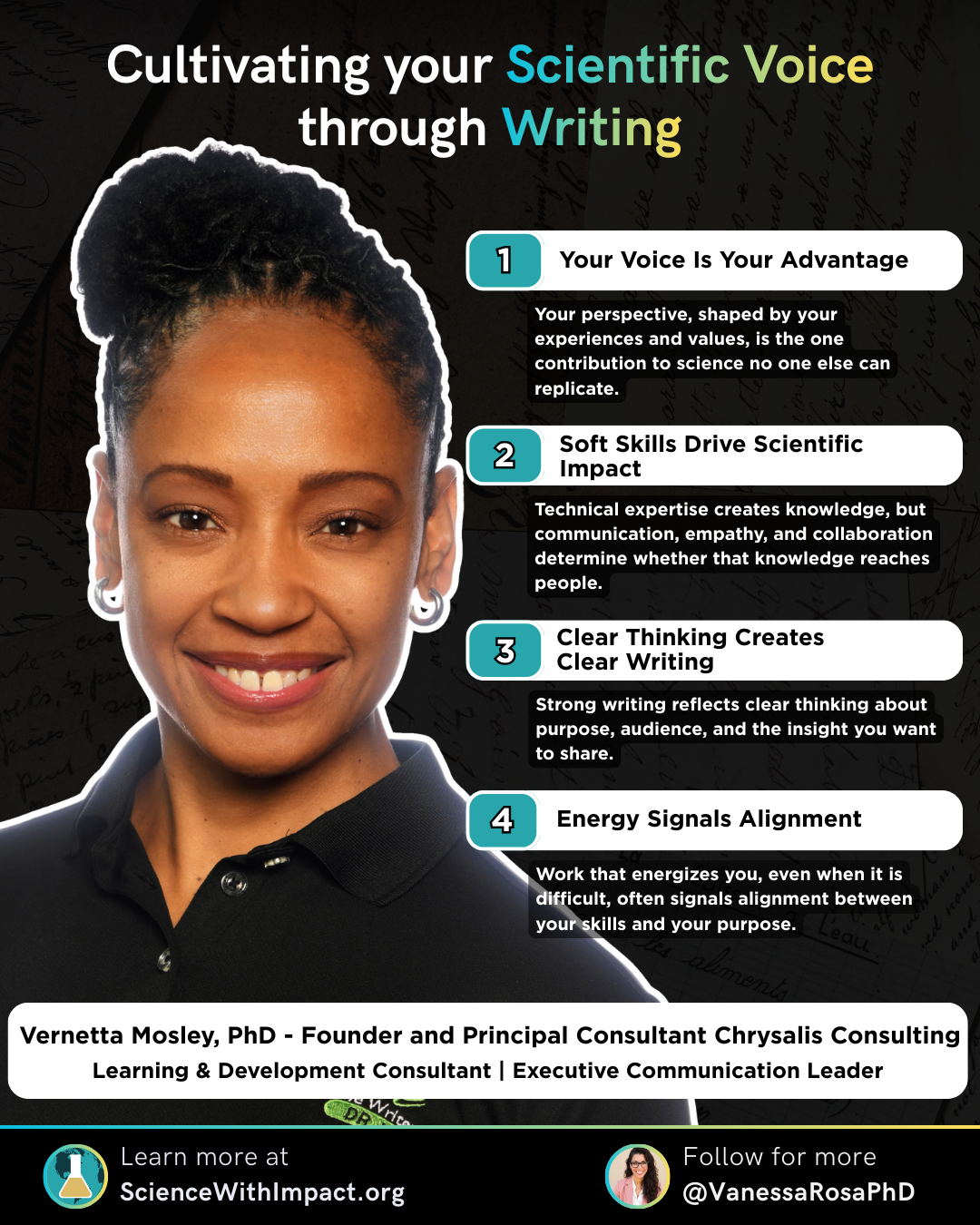
Your Voice Is Your Only Unique Contribution
The only truly unique thing you bring to science is your voice.
In Vernetta's words: "The only unique thing you have in this world is your voice as a person, as a scientist, or an organization wanting to make impact. How do you distinguish your voice from all the other voices out there?" Your research methods can be replicated. Your techniques can be learned by others. Your equipment can be purchased by competing labs. But your perspective, your way of seeing connections, your interpretation of findings—these emerge from your unique combination of experiences, training, and insight. Developing this voice requires moving beyond formulaic academic writing to communicate with clarity and authenticity about what your work means and why it matters.
Soft Skills Enable Hard Skills to Create Impact
Technical expertise without communication ability limits scientific impact.
We often hear researchers say they went into science because they preferred working with data over working with people. But as Vernetta points out, the ability to collaborate, to read a room, to manage emotional responses, to build relationships—these "soft skills" are what allow technical expertise to reach beyond the lab. A brilliant discovery that cannot be communicated effectively creates no societal benefit. The most successful scientists are not necessarily those with the most technical prowess but those who can combine technical knowledge with strong communication, emotional intelligence, and relationship building capabilities.
Writing Reflects Thinking Quality
Confused writing indicates unclear thinking that needs more development.
Vernetta shares a principle that transforms how we approach scientific writing: "Writing is just a picture of your thoughts." When your writing feels muddled or your voice seems lost, the problem is rarely with writing technique. Instead, you have likely started writing before your thinking has crystallized. The solution is to step back and clarify your thoughts first. Who exactly are you writing for? What specific purpose does this communication serve? What unique insight are you offering? Once your thinking is clear, your writing becomes dramatically easier and your authentic voice emerges naturally.
Energy and Joy Signal Alignment
Physical and emotional responses reveal whether your path aligns with purpose.
When Vernetta describes conducting a webinar after an exhausting week of travel, she noticed something remarkable: "Within 10 minutes of talking I felt so energized. I went for an hour and a half and it went by so quickly. Those are the things that confirm for me, this is what you need to be doing." Our bodies provide clear feedback about alignment. If you consistently dread your work, oversleep on weekends to recover, or feel drained even by tasks within your supposed expertise, these are signals worth heeding. Conversely, when you find yourself waking early with ideas, feeling energized even when physically tired, or losing track of time in your work, you have found alignment between your skills and your purpose.
Apply This to Your Work
Ready to begin cultivating your scientific voice? Here's how to start:
- This Week: Discover Your Unique Perspective
- Complete the foundational exercise from Step 1: Write down three research experiences that shaped how you think about your work, including at least one failure or pivot. What connections do you see now that you didn't recognize when others were looking at the same data? This is your unique perspective—the foundation of your irreplaceable voice.
- This Month: Practice Discovery Writing
- Block 20 minutes for discovery writing without editing. Set a timer and explore: What surprises me most about my current results? Why does this work matter beyond my field? What am I still uncertain about? Save this writing—it's not your draft, it's your thinking becoming visible.
- This Quarter: Build Your Support System
- Identify one person whose feedback you trust and ask them to review one piece of your writing monthly. Specify what kind of feedback you need: clarity, structure, voice, or audience appropriateness. Additionally, find or create one low-stakes environment where you can practice developing your voice—a writing group, mentorship relationship, or professional development program.
- Ongoing: Track Your Energy as Data
- For one week, note your energy level after each major work activity on a 0-10 scale. Which tasks energize you even when you're tired? Which drain you despite being "successful"? Patterns in this data reveal where your skills and purpose intersect—and where they diverge. Return to this practice quarterly to ensure continued alignment.
Conclusion
Your scientific voice is not something you create from scratch—it's something you cultivate through deliberate practice, protected space for growth, and consistent engagement with the communication strategies that transform technical expertise into societal impact.
Dr. Vernetta Mosley's insights reveal a fundamental truth:
the discoveries you make in your lab gain meaning only when communicated effectively.
Your unique perspective—shaped by your specific combination of training, failures, pivots, and insights—cannot be replicated by anyone else. This makes your voice not just valuable, but irreplaceable.
The roadmap provided in this article offers concrete steps you can implement immediately. Whether you're clarifying your thinking before drafting, separating discovery writing from dissemination writing, building resilience against critique, or using AI strategically rather than reflexively, each action strengthens your ability to communicate what matters most about your work.
Remember that writing reflects thinking. When your writing feels confused, you haven't started too soon—you've started before clarifying what you truly want to communicate. The solution isn't better writing technique; it's clearer thinking about your audience, your purpose, and your unique contribution.
As you develop your scientific voice, know that this is perpetual work. Even accomplished scholars like Dr. Mosley, who holds a PhD in English, continues to revise and refine every piece she writes. Growth is the ongoing process, not a destination to reach.
Your research has the potential to change lives, inform policy, and solve pressing challenges. But that potential is realized only when you can communicate clearly why your work matters and how it connects to the broader questions society faces. Cultivate your voice deliberately, protect it fiercely, and use it confidently to ensure your scientific contributions create the impact they deserve.
Join the Conversation
Thank you to Dr. Vernetta Mosley for generously sharing her expertise and profound insights on cultivating authentic scientific voice. Her wisdom on the essential connection between clear communication and scientific impact provides invaluable guidance for researchers at every career stage.
Thank you to our readers who make impactful science possible. If you're looking to expand your research program's societal impact—whether through strategic communication, workforce development initiatives, or comprehensive broader impact planning—we invite you to explore how Science with Impact can support your objectives. Schedule a consultation with Dr. Rosa to discuss research support services customized to your program's unique needs.

Let's collaborate
Schedule a meeting with our founder, Dr. Rosa, to explore how we can help broaden your impact.
Learn More
1. Evidence-based impact measurement and communication.
2. Lasting national and local partnerships with STEM organizations.
3. Impact-centered professional development for students.


Member discussion