
A few weeks ago I posted a clip I was proud of: glowing electron paths around a molecule in Genesis, with soft red domains and the caption that I wish I’d learned chemistry this way:
 Vanessa Rosa, Ph.D.
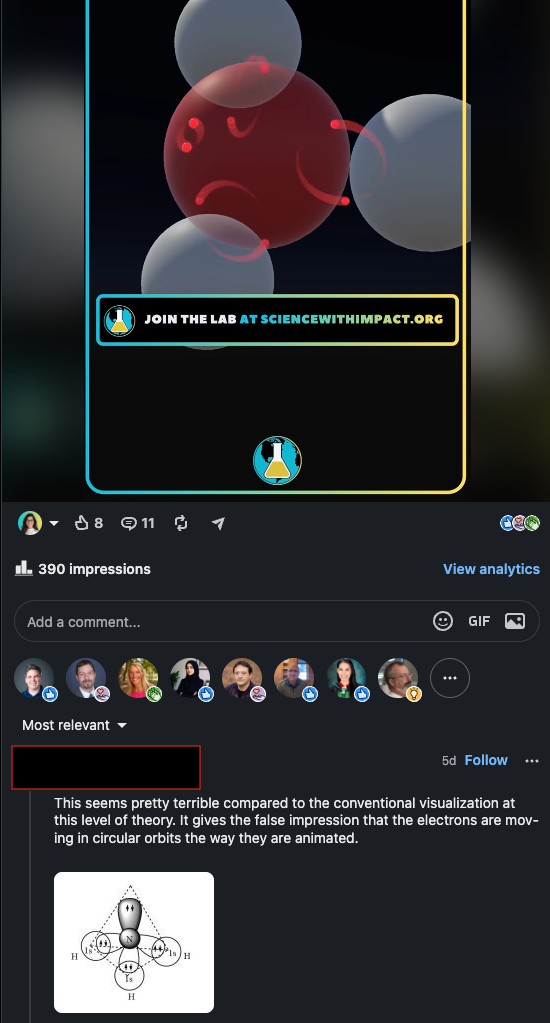
A colleague replied with a diagram of textbook hybrid orbitals — pairs of dots sitting inside lobes, not racing around rings — and wrote:
They were right.
Electrons aren’t little planets. They’re occupancy of regions. If the motion teaches the wrong story, the visual fails — no matter how pretty it is.
This post is about what we changed, why it matters for teaching, how you can use it today!
What we were trying to show (and what went wrong)
Chemistry is electron behavior. Lone pairs, σ vs π, polarity, reactivity — none of that lives in the colored ball alone. That’s why Genesis already invests so much in live valence topology and VSEPR domains (why we show electrons at all).
 Vanessa Rosa, Ph.D.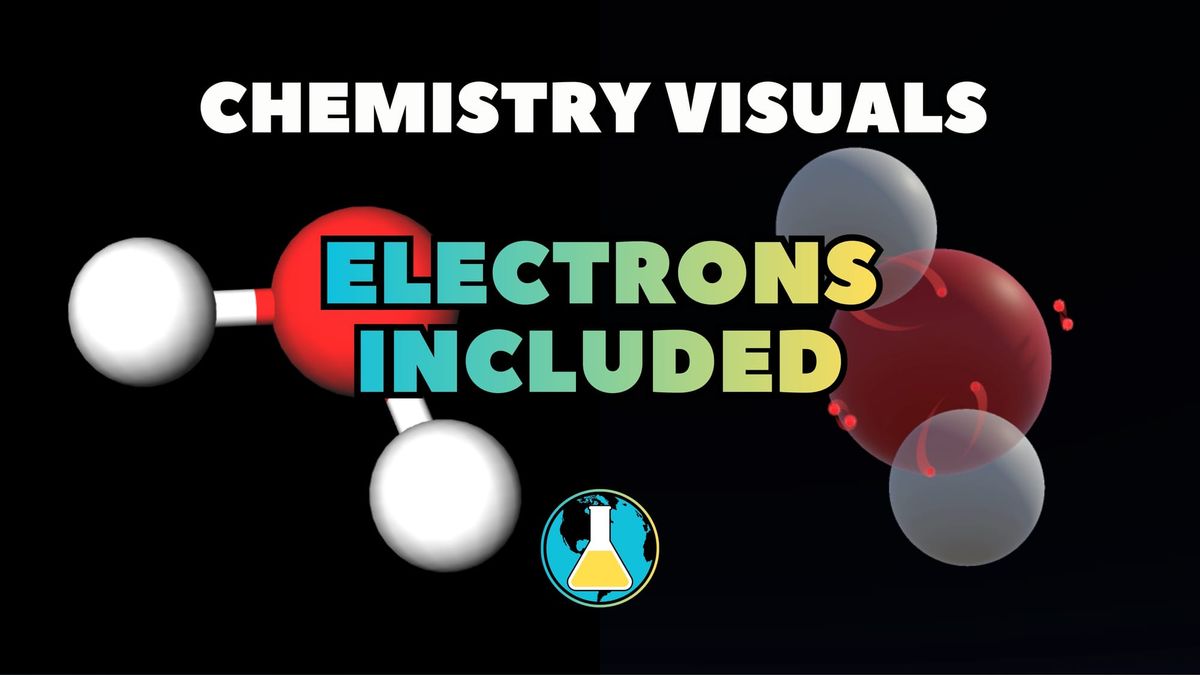
But motion is pedagogy. When countable red leptons raced on closed loops, they read as Bohr orbits — a very misconception we don't want to perpetuate.
The critique didn’t say “stop showing electrons.” It said: stop animating them as if they were on circular orbit paths.
That distinction became our R&D question:
Can we keep countable, teachable electron dots and soft domain envelopes — without implying planetary motion — while still running in real time on any browser?
What we built next (examples + you try!)
We extended our stack (modes, master toggle, VSEPR-steered lobes, multi-center LOD) and changed the parts that were visually inaccurate:
1. In-domain drift, not circular orbits
Valence dots and bond leptons now wander inside chemically meaningful envelopes — lone-pair lobes, σ contact regions, π faces — instead of completing neat circles. Trails still read as motion; they no longer redraw orbits.
2. Bond order as shape, rather than 3 orbiting paths
- Single: σ density in the interatomic contact
- Double: σ + one π dumbbell (not three stacked plates)
- Triple: σ + π + an orthogonal π
Students can see why a double bond has a reactive face, not only that it’s “order 2.”
3. Two clear communication modes
| Mode | What you see |
|---|---|
| Domain Clouds (default) | Soft probability-style lobes plus countable drifting dots inside them |
| Lewis Dots | Countable drifting dots (and drifted bond paths) without the lobe fill |
Legacy “hybrid / clouds + dots” prefs map cleanly onto Domain Clouds so saved settings don’t break.
4. Polarity and ions without a second chemistry engine
Polar covalent density shifts toward the more electronegative atom. Ionic pairs bias density toward the anion facing the cation:
5. What you save is what you taught
Save Molecule / Save Scene now export compact domain ellipsoids and drift motion into the browser viewer — see-through enough to read atoms and dots, without blanking large scene opens.
Feedback → product (how we work)
I work in public on purpose — because chemistry communication is vital to our field and fresh eyes catch risks and errors.
If you want the next electron visual, reaction family, or classroom drop before it hits a press post — or you want a physical artifact that unlocks the sandbox — here’s how:

Your support funds the tedious, expensive middle of innovation.
Sincerely,
Vanessa Rosa, Ph.D.

The most impactful resources are built in community.
P.S. If your critique is as sharp as the one that started this pass — reply to this email with a structure or misconception you still see in our clips. Insiders hear what we try next; Catalysts help vote it onto the bench!
Lab notes (R&D dissemination — for the public record)
This section is intentionally plain. It documents process of experimentation for scientific communication and qualified research dissemination.
Business component: Project Genesis — electron-domain teaching visuals (Unity Lab) and Molecule Viewer export.
Technological uncertainty at the outset: Whether real-time valence leptons could stop reading as Bohr planets without a full quantum renderer; whether multiple bonds could teach as σ + distinct π faces (not only thickened geometry) at interactive framerates; whether polar/ionic density bias could reuse existing electronegativity data; whether browser export of domain visuals could match Play Mode without exceeding local storage limits and blanking Save Scene.
Qualified purpose: Improve the function and quality of a commercial educational simulation — specifically the correctness of the mental model students form from electron motion and bond-order shape — and the reliability of exported teaching artifacts.
Evidence of work product: Internal contemporaneous log entry 2026-07-22 — In-domain electron drift, σ/π Domain Clouds, 2-mode UI, viewer/export parity (R&D_LOG.md); geometry unit tests for covalent lobe counts and EN density anchors; Play Mode + Save Molecule/Scene verification that motion is drift, clouds are see-through, and large scenes open.
What we’re not claiming: That Domain Clouds are ab initio orbitals, that colors encode energy or phase (±), or that antibonding (*) is visualized. Those remain parked under a future Orbital mode so we don’t conflate pedagogical roles.
Process of Experimentation
| Approach | Outcome |
|---|---|
| Shorten comet trails only; keep circular angular motion | Rejected — still read as orbits |
| Three stacked π “plates” for doubles | Rejected — double = σ + one π dumbbell |
| Keep three player modes (Clouds / Lewis / Hybrid overlay) | Simplified — Domain Clouds = lobes + countable drift; Lewis = dots; Hybrid int remapped for prefs stability |
| Dump high-resolution cloud triangle meshes into scene JSON | Failed — multi‑MB payloads → sessionStorage quota → blank viewer |
| Compact ellipsoid export + drift parameters + sibling payload.js bootstrap | Adopted |


Member discussion