Have you ever failed upwards?
Recently, I simultaneously 1) failed to answer two essential questions while pitching a project to the U.S. National Science Foundation's SBIR Program Officer, AND 2) got invited to host a workshop on Elevator Pitches with the graduate students and postdocs of the foundation's Center for Single-Entity Nanochemistry and Nanocrystal Design (CSENND). The opportunity to teach something I'd learned by failing is ironic and invaluable. Here are 3 things I learned about pitching science:
#1. Lead with discoveries
People have brilliant ideas for industry and research all the time. What elevates a pitch is the underlying discoveries you've made that led to what you're proposing.
What product/service/resource didn't exist when you needed it and what did you do to unlock the foundational information required to bring it to existence?
FYI: This is also referred to as the "secret sauce." When I was asked what my "secret sauce" was, it took me a moment to realize this phase isn't about cooking 😮.
#2. Follow with moats
If you really want to strengthen a pitch, mention what prevents anyone else from taking this idea and doing it better than you. Metaphorically stated as your "moat", this is the Intellectual Property (IP), experience, or unique overlap of disciplines/skillsets/partners that makes your product/business/project uniquely challenging to copy.
What unique knowledge and resources belong to your team that address an unmet need in a way that other technically competent teams cannot easily replicate?
#3. Write how you speak
This one surprised me. As I was talking to my collaborators and program officer about the project, several of them noticed the way I explained it on Zoom was far more clear and engaging than in my written work.
I had to take some time to reflect on this, but when I write, often I write as I would to an expert; when I am asked to explain the same ideas in person, I speak as I would to a friend. Losing the humanity in my writing has gotten worth with the advent and use of AI, when I spend more time editing AI written drafts of my ideas than I do envisioning and drafting things on my own.
My takeaways?
- Keep AI in the correct lane: great for synthesizing text (outlines for example) and for checking grammar; but...
- Let your first draft be the transcript of a voice recording: Ideally one where a close friend or colleague has a list of questions to ask you, so you really speak as you would to someone close to you (but not necessarily an expert in your particular niches).
The unique way you say things based on your authentic experiences is the ultimate discovery and moat.
Let's Improve the Pitch
Going into the NSF CSENND Workshop on Friday, July 31st (invitation below), I've developed a simple frameworks to help others start honing their pitches:
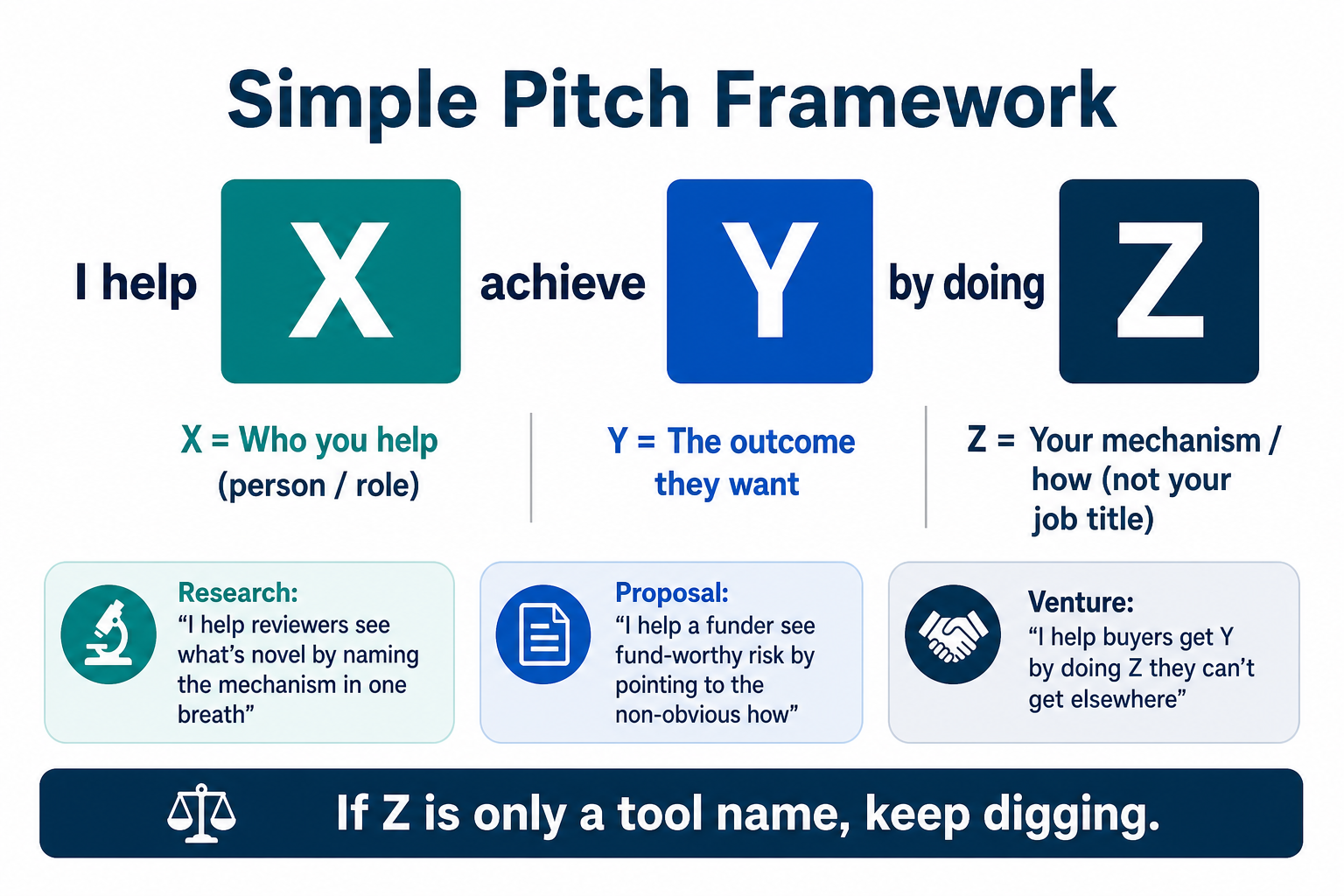
Here's my pitch:
I help chemists share mechanisms of action and measure engagement, using 3D chemistry simulators that runs in any browser, spawning reacting molecules.
The discoveries:
I've solved three challenges to live reacting molecules:
- Allowing chemistry structures to morph across different confirmations while maintaining accurate molecular geometries using bond-by-bond tracking,
- Keeping only active sites live to prevent macromolecules from crashing a browser, and
- Placing geometries from known chemistry rather than relying on physics alone to prevent compounding errors on polymer strand bond angles.
And the moat:
What’s hard to copy is the combination of assessment-ready engagement measurement, live visuals audiences will actually watch, and the chemistry-engine work that keeps those reactions accurate in-browser.
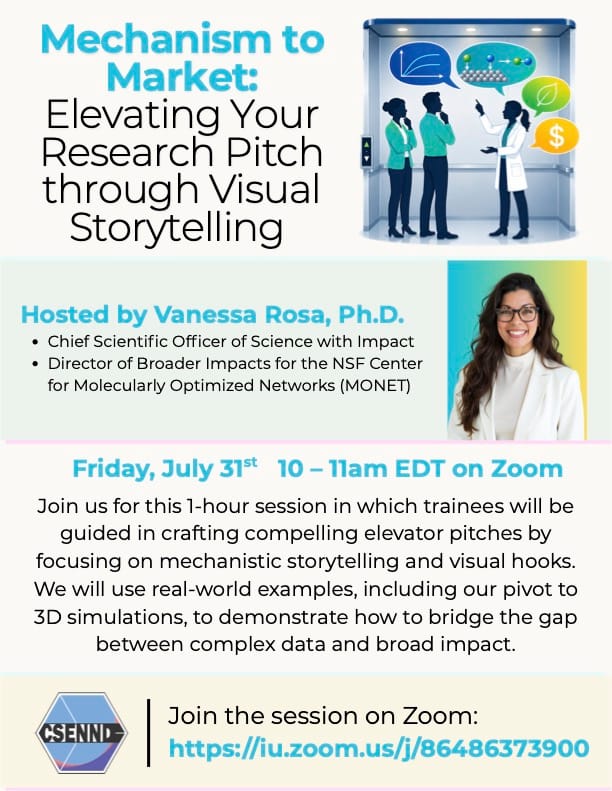
You're invited!
The NSF Center for Single-Entity Nanochemistry and Nanocrystal Design (CSENND) is hosting an upcoming workshop on visual storytelling, and Vanessa Rosa, Ph.D. of Science with Impact and The NSF-Funded Center for Chemical Innovation: Molecularly Optimized NETworks (MONET) is leading the session!
Join us on Friday, July 31 for "Mechanism to Market," a 1-hour workshop on elevating your research pitch. We will cover how to clearly communicate complex data to any audience using mechanistic storytelling and visual hooks.
📅 Friday, July 31
⏰ 10:00 – 11:00 AM ET
📍 Join via Zoom (link in the comments, DM me and I'll add you to the calendar)
Note: Any opinions, findings, and conclusions expressed in this post are those of the author and do not necessarily reflect the views of the U.S. National Science Foundation.


Member discussion