What happens when leaving a PhD program becomes the catalyst for building something more authentic?
Aneesa Valentine transformed the difficult decision to leave her computational genomics PhD into a systematic career transition—and eventually, a company. Today, as founder of ImpaktBio and a bioinformatics solutions architect, she helps researchers work with biological data at scale while staying true to what she calls being a "scholar"—someone who pursues knowledge for its own sake, not for citations or recognition.
On this episode of Science With Impact, we explore the gap between what academic training prepares us for and what actually fulfills us as scientists. Aneesa shares a practical skills audit framework that any researcher can replicate, demonstrates how computational tools amplify biological insight rather than replace expertise, and explains why community matters more than metrics when building a career with purpose.
Whether you're navigating career uncertainty, learning to leverage AI in your research, or questioning whether traditional success markers align with your values, this episode offers strategies for mapping your skills to unexpected opportunities, building careers that honor both technical expertise and deeper purpose, and creating sustainable impact outside conventional academic paths.
Meet Aneesa Valentine
Aneesa Valentine is a computational genomics scientist and founder of ImpaktBio, a company that makes bioinformatics training accessible to researchers working with biological data at scale. After a systematic skills audit during a challenging PhD experience, she left academia to build something aligned with her values.
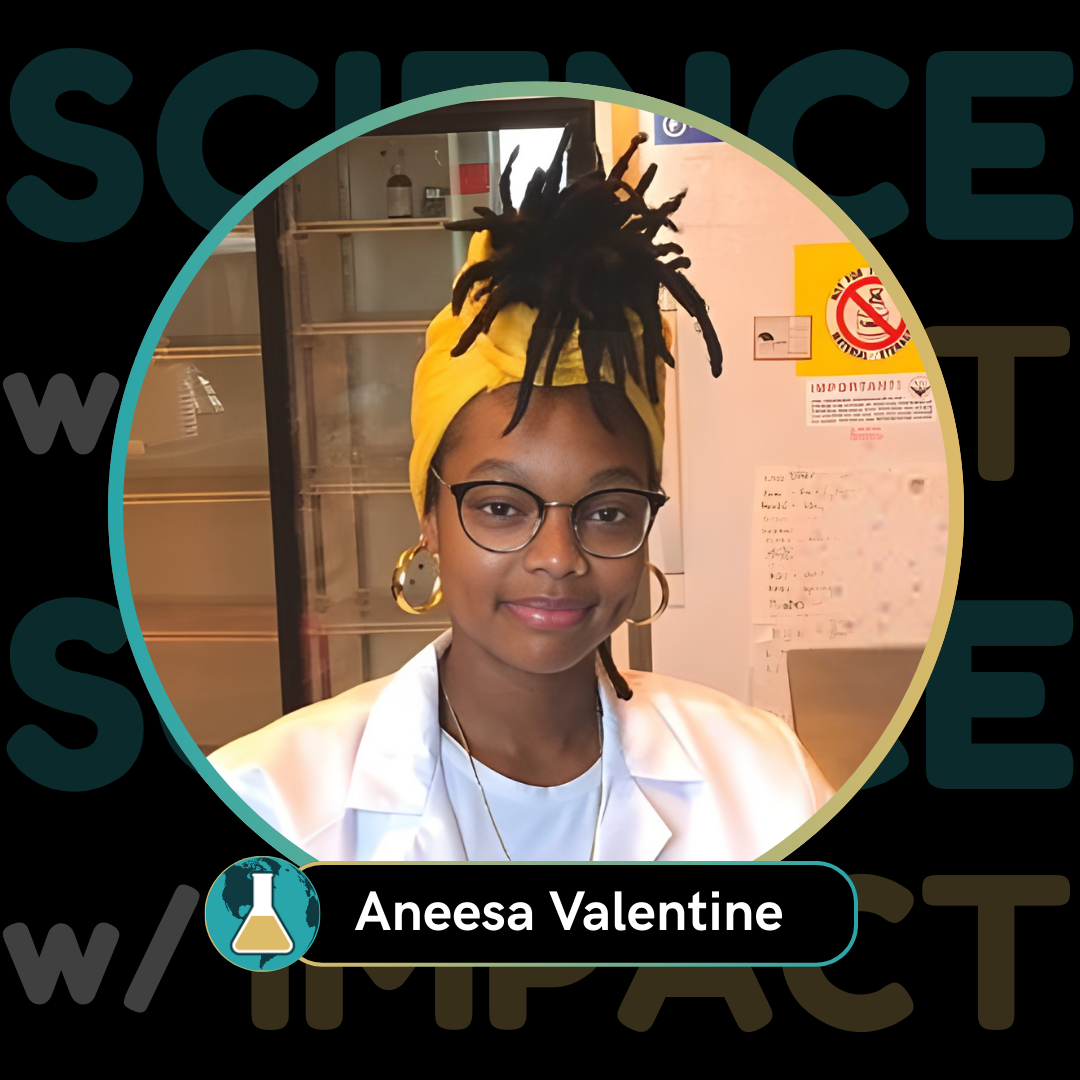
Growing up in Dominica—an island of just 70,000 people—Aneesa always wanted to be a scientist despite limited scientific representation. After moving to Brooklyn for her PhD at Albert Einstein College of Medicine, she discovered computational genomics. Computers could answer biological questions in ways traditional wet lab methods couldn't. This revelation shaped her career trajectory, though she never imagined starting her own company.
Today, Aneesa works as a bioinformatics solutions architect, analyzing single-cell RNA sequencing data to understand how genetic profiles shift during development and disease. Using Python libraries like Scanpy and visualization tools like Matplotlib, she processes thousands of cells simultaneously, revealing patterns impossible to detect through traditional methods. Her work shows how computational approaches amplify biological insight rather than replace the deep mechanistic knowledge essential for asking meaningful questions.
Founding ImpaktBio revealed something unexpected: the power of community. What began as a sole proprietorship focused on training evolved into something centered on connecting with researchers, educators, and organizations who share her values.
"My focus right now is community—surrounding myself with like-minded individuals who are doing the work in different ways, but with the same goals."
ImpaktBio: Making Bioinformatics Accessible at Scale
ImpaktBio emerged from a simple observation: researchers across biology increasingly need to work with complex genomic datasets, yet most lack formal training in the computational tools required to analyze them effectively. The company fills this gap by providing practical instruction in Python, R, single-cell analysis pipelines, and cloud computing platforms to researchers who need these skills but can't pause their careers for formal computer science degrees.
What makes ImpaktBio distinctive is its commitment to being a scholarly enterprise rather than purely commercial. Beyond paid training programs, Aneesa creates free resources through her Substack, shares open-source code repositories, and prioritizes community building over extraction. This approach reflects a deeper purpose: stewarding knowledge in ways that serve the scientific community rather than simply monetizing expertise.
For research scientists navigating the increasingly computational nature of biological research, ImpaktBio represents both a resource and a model—showing how individual expertise can scale through teaching, how community can sustain entrepreneurship, and how staying true to your values doesn't require abandoning practical sustainability.
A Roadmap for Research Scientists: The Skills Audit Framework
Faced with an unsupportive PhD environment in 2022, Aneesa created a systematic approach to career transition that any researcher can replicate. This framework has become a roadmap for scientists navigating uncertain career paths—whether leaving academia, pivoting within industry, or clarifying their next step.
Phase 1: Identify Roles That Interest You (Week 1)
Aneesa searched LinkedIn for positions in computational biology, bioinformatics, and data science—jobs that aligned with her computational interests but existed outside traditional academia. "I decided to leverage LinkedIn in a way that at the time most folks weren't. And I decided to go look up folks who, random strangers who had jobs that I wanted to do." The key is casting a wide net initially without worrying about whether you're "qualified" yet.
Action steps:
- Search LinkedIn, Indeed, and company career pages for roles that genuinely interest you
- Save 10–15 job postings that represent different aspects of what appeals to you
- Don't filter by qualifications at this stage—focus on discovering what exists
Phase 2: Map Required Skills to Your Current Abilities (Week 2)
She documented every skill listed in job postings (Python, R, machine learning, cloud computing) and honestly assessed what she could already do versus what she needed to learn. "I quite literally would take note of all the skills required in those job postings. Things like Python programming r programming, depending machine learning all the things. And I mapped that to what I knew how to do." This honest self-assessment is critical—overestimating creates false confidence while underestimating leads to unnecessary delay.
Action steps:
- Create a spreadsheet with three columns: Required Skill, Current Level (None/Basic/Intermediate/Advanced), Gap to Close
- List every technical skill, tool, and qualification mentioned across your saved job postings
- Be brutally honest about your current abilities—this is for you, not a resume
- Identify patterns: Which skills appear most frequently? Which gaps are smallest to close?
Phase 3: Bridge the Gaps Strategically (Weeks 3–10)
When she discovered that most roles required Python but she only knew R, she used free resources like DataCamp and GitHub repositories to teach herself. "I knew how to code an r. But this job wants someone who knows how to code in Python. So how do I get from R to Python? And then once I figured out my, my outcomes, then it was on me to go do research to actually upskill myself. So learning Python looked like doing free resources like DataCamp, which is still ongoing right now. Looking up random GitHub repose to see what folks were doing, trying to reproduce their code, that sort of thing." Over two intensive months—while simultaneously preparing for her qualifying exam—she acquired enough knowledge to land her first industry role as a data scientist.
Action steps:
- Prioritize skills that appear in multiple job postings and bridge the smallest gaps first
- Use free resources strategically: DataCamp, Coursera audits, YouTube tutorials, GitHub repositories
- Build a portfolio project that demonstrates your new skills in action
- Set a realistic timeline—Aneesa's two months was intensive, but timelines vary by skill complexity
Phase 4: Look Beyond Technical Requirements
Aneesa emphasizes that "hard skills are important, but past a certain point, especially now with AI, how do you show up in a workplace? How do you navigate interpersonal relations? How do you collaborate cross-functionally?" The ability to communicate complex findings to diverse audiences often matters more than coding proficiency alone.
"I hate when people talk about hard skills and like over index on hard skills. Our skills are important, don't get me wrong. I need to be assured that you can do the job effectively. But, passed a certain point, especially now with ai how do you. Like show up in a workplace. how do you navigate interpersonal relations? Because that is like 90% of any job."
Action steps:
- Assess your soft skills honestly: communication, collaboration, conflict resolution, project management
- Identify examples from your research experience that demonstrate these abilities
- Practice translating technical work for non-technical audiences
- Consider how you've navigated interpersonal challenges in lab settings—these stories matter in interviews
This framework works because it's honest, systematic, and action-oriented. It doesn't require you to know your "dream job"—just your next viable step. By following these phases, researchers can transform career uncertainty into strategic action.
Understanding Today's Computational Biology Landscape
The computational biology field has transformed dramatically. When Aneesa began, "data scientist" was the coveted role everywhere—from eCommerce to genomics. These professionals analyzed data, built predictive models, and extracted insights within their domains.
Now? AI handles much of that routine work. The real demand has shifted to data engineers and solutions architects—people who design infrastructure, work with cloud platforms like AWS, build pipelines in Nextflow, and architect systems that support AI.
"The isolated data scientist is not as popular as it used to be," Aneesa explains. "You kind of need to know the infrastructure stuff too now."
This reflects a bigger shift: as AI takes over lower-level tasks, human expertise moves toward higher-order thinking, system design, and strategic decisions.
For mid-to-senior scientists, this is liberating—finally free from tedious tasks to focus on critical thinking. For early-career researchers? Much harder. "I've got friends who just graduated with their PhDs in some sort of bioscience area and they are struggling to find jobs even with this advanced degree and years of accumulated domain knowledge," Aneesa notes. "That's really sad because then the talent pipeline dries up and that's not something that gets replenished overnight."
Computers as Biological Inquiry Tools
Imagine peering into thousands of individual cells at once, watching their genetic signatures reveal secrets invisible to traditional microscopes. That's Aneesa's world—where Python libraries like Scanpy and visualization tools like Matplotlib transform raw transcriptomic data into biological insight.
The analysis begins with detective work. Violin plots overlaid with scatter plots expose the messy reality: not every cell in the sample is healthy or worth analyzing. By scrutinizing gene counts, total RNA transcripts, and mitochondrial gene expression, Aneesa identifies the dying cells and experimental noise that could skew results. "We still need to acknowledge the fact that whatever the folks did in the wet lab experimentally might not have been perfect or foolproof," she notes.
Once the data is clean, the real magic happens. Techniques like principal component analysis (PCA) and UMAP—uniform manifold approximation and projection—cluster cells based on their genetic fingerprints. Picture mapping an entire developmental journey: cells collected from embryonic day 1 through day 5, each revealing how genetic profiles shift as life unfolds. "Computers can help us understand how genetic profiles shift during embryonic development," Aneesa explains. This systems-level view—thousands of cells across multiple conditions simultaneously—would cost a fortune and take years using traditional wet lab methods alone.
But here's the crucial insight: these computational superpowers mean nothing without deep biological knowledge. AI can write code and run analyses, but it flounders without expert guidance.
"AI is still not helpful if you don't know what you're doing. Like it sends me in circles often unless I specify, no, I want you to use this package. I want you to write it in this programming language."
The tools don't replace expertise—they multiply it, letting researchers ask bigger questions and test hypotheses that would have been impossible a decade ago.
The Scholar vs. The Academic
Aneesa recently discovered a newsletter called The Scholarly Letter that finally gave words to something she'd felt but couldn't name: the difference between being an academic and being a scholar.
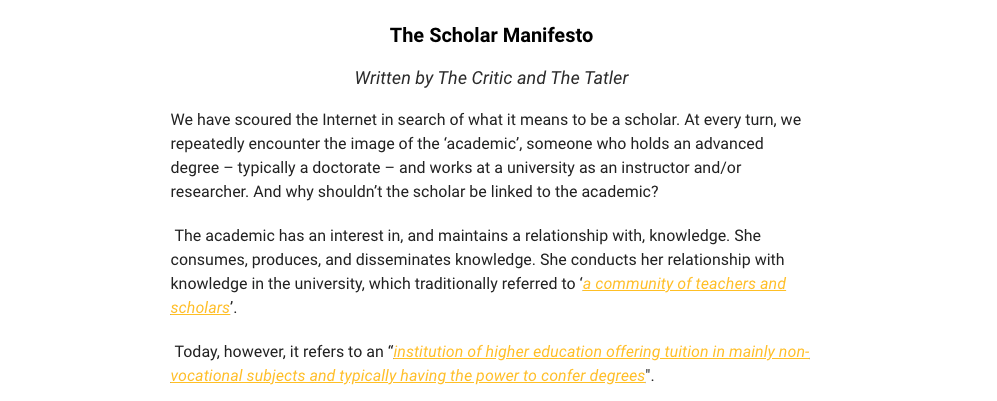
An academic—through no fault of their own—has been forced to turn science into a product manufactured for success metrics: high-impact publications, citation counts, funding amounts. "They make two distinctions, one between the academic and the other being a scholar. The academic is someone who, by no sort of reason of her own doing, has turned science into a product—something to be manufactured, something attached to certain success KPIs." The system rewards these outputs, so pursuing them becomes rational, even necessary for survival.
A scholar? They pursue knowledge for its own sake. "The scholar is in pursuit of knowledge that is going to better humanity," Aneesa explains. "She doesn't care about being cited. She doesn't care about making money off of a scientific product. She's just doing science because she loves stewarding knowledge."
That language—"stewarding knowledge"—resonated deeply with Aneesa. It explains why founding ImpaktBio felt so different from traditional career paths, and why she invests time creating free Substack resources despite no direct financial return.
"I assume almost a duty of care for the knowledge that I steward," she says. This duty extends through her training programs, open-source code repositories, and conversations like this one—all aimed at making bioinformatics accessible, ethical, and sustainable.
For researchers feeling the tension between what the system rewards and what their curiosity craves, this distinction offers language for an alternative path. You can be excellent without being extractive. You can be impactful without being commercial. You can be successful while staying true to why you fell in love with science in the first place.
Key Lessons for Navigating Scientific Careers With Intention
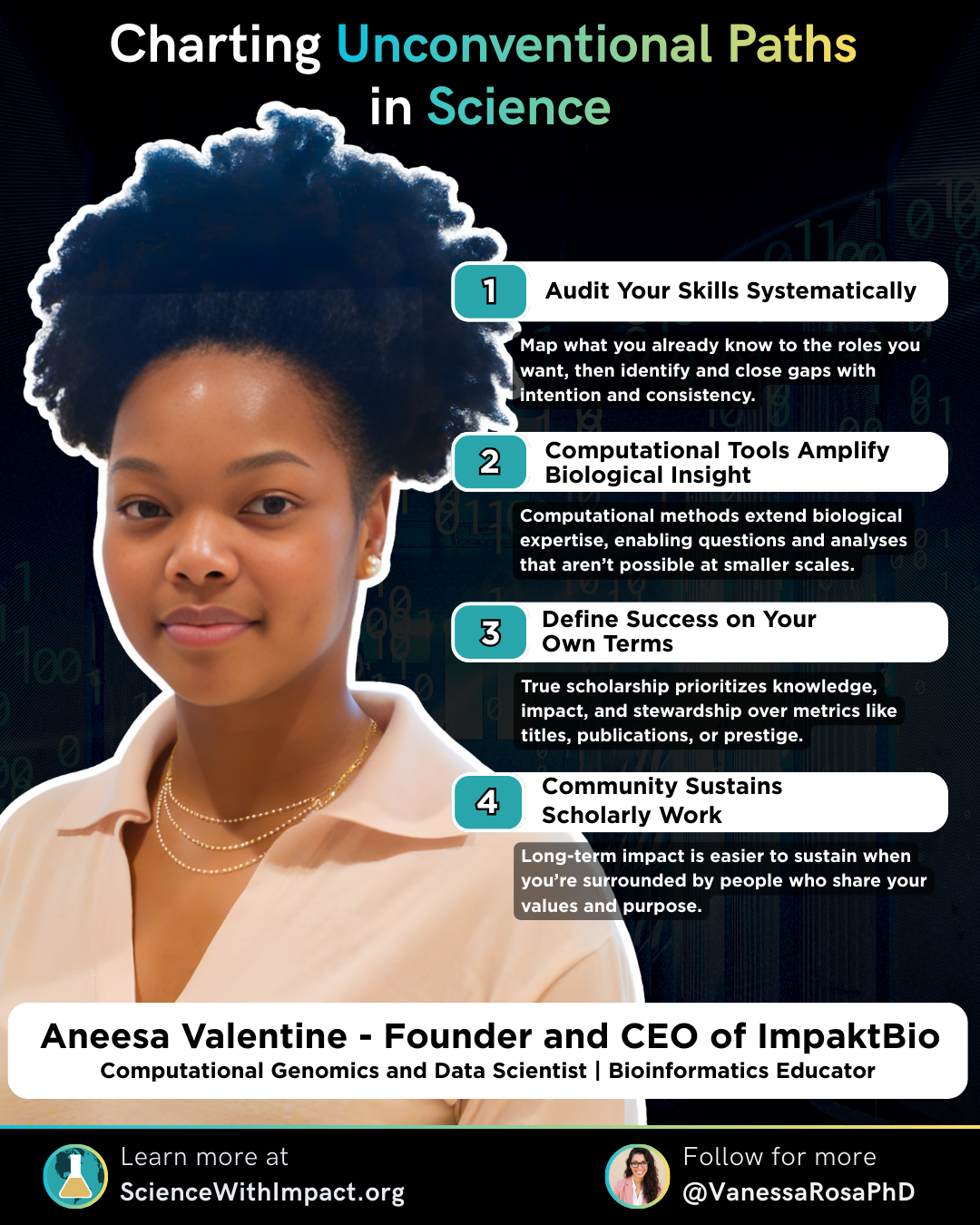
Audit your skills systematically:
Map what you can do to roles you want, then bridge gaps strategically.
When Aneesa needed to transition out of her PhD program, she didn't panic—she created a methodical process. She identified interesting roles on LinkedIn, documented every required skill in those job postings, mapped what she already knew, and systematically learned what was missing. Over two months of intensive self-directed learning using free resources, she acquired enough Python and machine learning knowledge to land her first industry position. This approach works because it's honest about current abilities, realistic about gaps, and action-oriented about filling them.
Computational tools amplify biological insight:
Learn to leverage technology that extends your expertise at scale.
Aneesa's work analyzing single-cell RNA sequencing data illustrates how computational approaches answer questions impossible with traditional methods. By processing thousands of cells simultaneously, researchers can map gene expression dynamics across developmental stages, identify distinct cell populations, and understand how genetic profiles shift in disease states. The key insight: these tools don't replace biological knowledge—they multiply its impact. A deep understanding of cellular mechanisms remains essential for asking the right questions, interpreting results correctly, and designing meaningful experiments.
Define success on your terms:
Being a scholar means pursuing knowledge for its own sake, not just for metrics.
The distinction between academic and scholar helped Aneesa articulate why certain career paths felt hollow while others resonated. Academics—often through no fault of their own—must turn science into a product measured by publications, citations, and funding. Scholars pursue knowledge to better humanity, caring more about stewarding understanding than accumulating metrics. This doesn't mean scholars can't publish or get funded, but those outcomes serve the knowledge rather than define the purpose. Aneesa describes feeling "almost a duty of care for the knowledge that I steward" through ImpaktBio, her Substack, and open-source contributions—work that fulfills her regardless of traditional success markers.
Community sustains scholarly work:
Surround yourself with people who share your values, even if their methods differ.
When Aneesa founded ImpaktBio, she initially envisioned a sole proprietorship focused on training. The company evolved into something centered on community—connecting with researchers, educators, and organizations who care deeply about making science accessible and impactful. "Founding this company has shown me the power in loving and caring about people and community," she reflects. This network of like-minded individuals pursuing shared goals through different methods provides both practical support and deeper fulfillment. "In order to keep going in this space, particularly outside of academia, you gotta have a really solid why," she notes. In spaces that can be isolating and require thick skin, community becomes essential infrastructure for sustaining your why.
Conclusion
Aneesa Valentine's journey from computational genomics PhD student to founder of ImpaktBio reveals a powerful truth: you don't need to follow a traditional path to build a meaningful scientific career.
Through systematic skills audits, strategic upskilling, and a commitment to stewarding knowledge rather than chasing metrics, she created a career that serves both her purpose and the broader research community.
Her four-phase framework offers a concrete roadmap for researchers facing career uncertainty: explore roles without self-filtering, map skills honestly, bridge gaps strategically, and look beyond technical requirements to soft skills that matter. This approach transforms anxiety into action because it's grounded in reality about where you are and what you need to learn next.
Most importantly, Aneesa embodies what it means to be a scholar in an age that often reduces science to products and metrics. Through ImpaktBio's training programs, her Substack, and open-source contributions, she demonstrates how to build a sustainable career while maintaining scholarly values. Her work making bioinformatics accessible—regardless of direct financial return—shows that impact and integrity can coexist.
As computational biology evolves and AI reshapes the landscape, researchers who can navigate these changes while staying true to their core values become essential. Aneesa's story offers both practical strategies and philosophical grounding for building careers that honor expertise and purpose alike.
Taking Action: Your Next Steps
If you're a graduate student or early career researcher navigating career transitions:
- Conduct a systematic skills audit: Identify roles that interest you, document required skills from job postings, map what you already know, and systematically learn what's missing using free resources.
- Prioritize soft skills development: Beyond technical abilities, focus on communication, collaboration, and how you navigate interpersonal dynamics—these matter more than coding proficiency alone.
- Practice translating technical work: Develop your ability to explain complex research findings to non-technical audiences, as this skill is essential across industry roles.
- Connect with community: Surround yourself with people who share your values and can provide support during transitions—isolation makes career pivots exponentially harder.
- Define your "why": Clarify whether you're pursuing the scholar's path (knowledge for its own sake) or the academic path (metrics and products)—both are valid, but knowing your purpose guides decisions.
For mentors and educators supporting career transitions:
- Provide honest feedback about career paths: Help students understand both traditional academic routes and alternative paths without judgment.
- Share resources for self-directed learning: Point students toward free platforms and communities where they can acquire industry-relevant skills.
- Normalize diverse definitions of success: Validate that impactful scientific careers can exist outside traditional metrics of publications and citations.
- Foster communities of practice: Create spaces where students can connect with professionals pursuing various career paths in science.
Join the Conversation
Thank you to Aneesa Valentine for sharing your journey and for your commitment to stewarding knowledge in ways that serve the scientific community. Your work through ImpaktBio, your Substack, and open-source resources embodies the scholar's approach to science.
Thank you to our readers who make impactful science possible. If you're looking to expand your research program's societal impact—whether through strategic communication, workforce development initiatives, or comprehensive broader impact planning—we invite you to explore how Science with Impact can support your objectives. Schedule a consultation with Dr. Rosa to discuss research support services customized to your program's unique needs.
Let's collaborate
Schedule a meeting with our founder, Dr. Rosa, to explore how we can help broaden your impact.
Learn More
1. Evidence-based impact measurement and communication.
2. Lasting national and local partnerships with STEM organizations.
3. Impact-centered professional development for students.


Member discussion